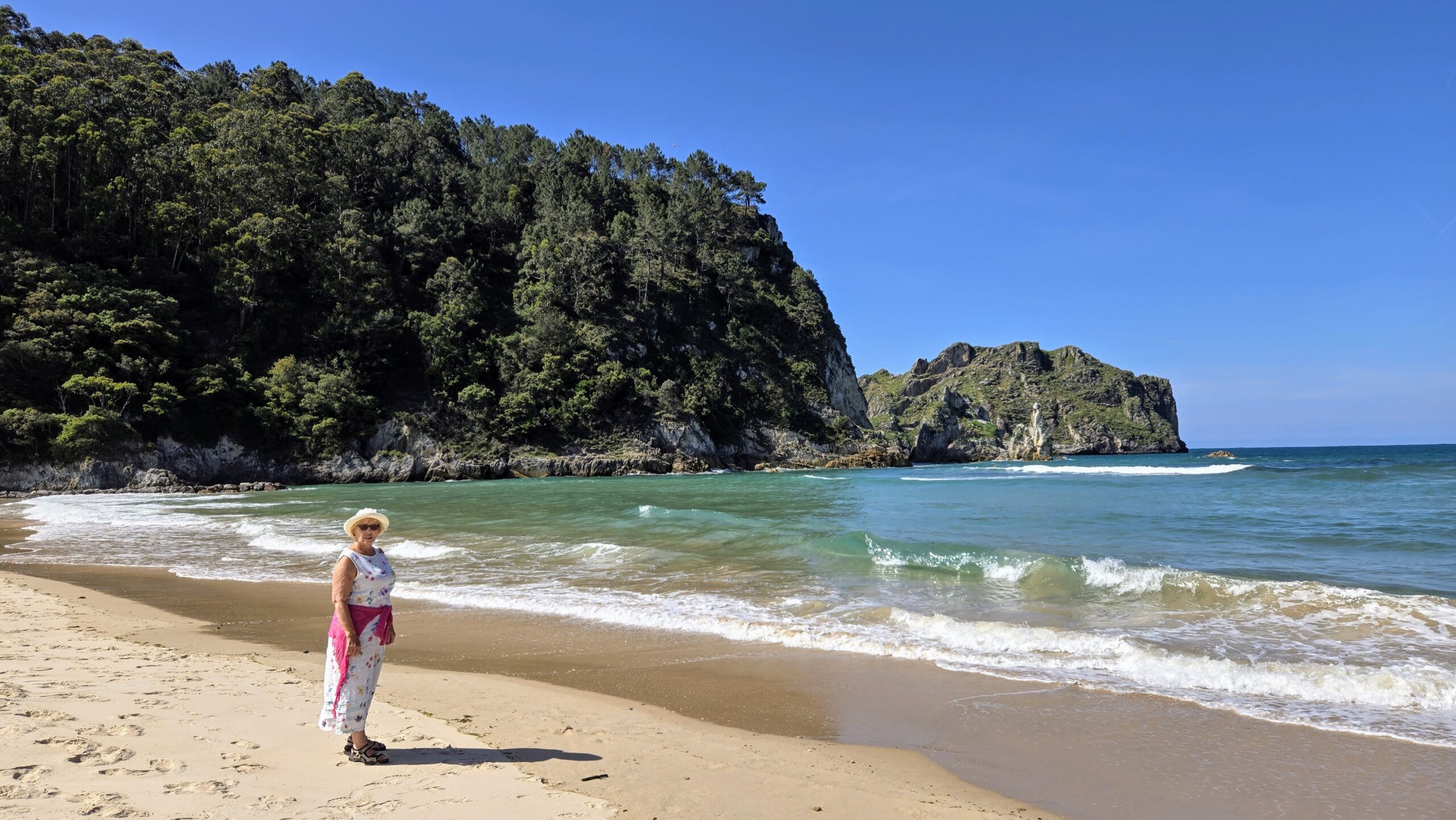
At Matignon, we are very close to the coast. The Emerald coast, stretching from Cancale to Cape Fréhel, it’s so named because of the turquoise-green waters hereabouts. First stop, the Plage de Quatre Vaux. I think that means beach of the four valleys. I’m not sure, however there certainly were several serious ups-and-downs on the approach and departure roads. But never mind the name. The beach came with extensive free parking within two minutes walk of the sand. There was a nice grassy, shaded picnic area (with free loos). And there was a campsite 100 m up the road. I’m guessing this place will be jammed in a couple of weeks when the school holidays start. But for now there were only half a dozen cars present. So the beach wasn’t exactly crowded. Although, to be fair, French people traditionally tend to hit the beach in the late afternoons.
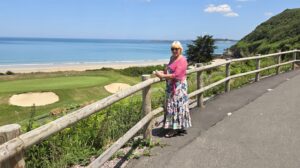
Just inland of the next beach we decided to get our non-golf-club-member cards out again. We are ready for coffee! Coffee with a view! At Golf de Saint-Cast. I think if we lived near here, I would get a real membership card! Social, of course. I don’t want be looking for balls in the long grass all the time!
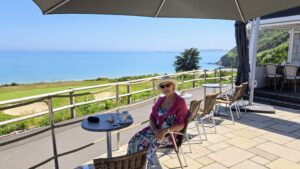
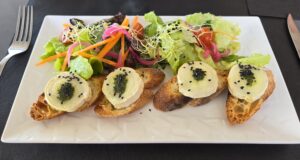
By the time we had finished our drinks it was lunch time! And people started streaming in. The restaurant was “complet”, but having struck a life-long friendship with the manager-cum-barman by talking to him and a couple of real club members in French for 10 minutes, we got special dispensation to have a table for two above “kitchen capacity”. And very good it was too, although that’s not our spot!
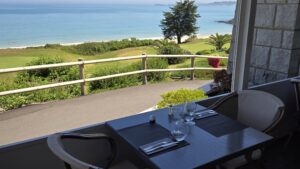
… but that is my goats’ cheese starter!
There’s no direct access to Pen Guen beach from here. A move to keep non-members at bay, no doubt!
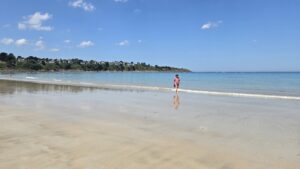
At about two kms long, that’s a long paddle. I really wished we had packed the swimming togs today!
Resting at half time.
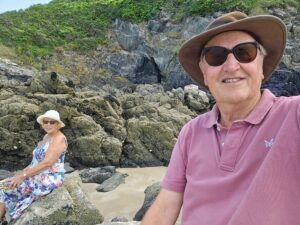
It’s all go. This holiday lark can be quite exhausting. Especially when the mercury is showing in excess of 30°C.
Drosera is the latin name for a carnivorous, insect-eating plant. The Honey-dew. It’s also the name of a restaurant in the middle of nowhere about mid-way between the sleepy villages of Fréhel, Pléboulle and Petit Trécelin. La Drosera. A weird name for a rather up-market, middle-of-the-countryside resto with green credentials. It maintains it’s up-markedness by having two carparks (one for white vans and one for cars) and two dining areas (one for white van-men and one for the elite), but it appears to serve the same food in both. Because we are new to the system, we parked with the van-men, but ate with the better dressed contingent. Weird and wonderful – and very “green”…

(The little mossy people did have feet, I just haven’t mastered the art of collaging photos!)
We are heading to the northeast tip of the Plévenon Peninsula. The beaches on the east side are difficult to access and when you do, they are a bit muddy and largely given over to oyster production. But the whole area seems deserted. We need a coffee. How about a latte. We’ve seen a couple of signs saying “Latte, this way!” We arrive at the much vaunted coffee station to find the place overrun with visitors. Hundreds of them. Not sure where they have come from. Certainly not from the rural areas that we have just come through. It transpires we are at the Fort La Latte, Chateau de la Roche Goyon. So much for the coffees!
This impressive castle was built in the 14th century by the Lord of Matignon, Etienne III Gouÿon. (He probably owned the campsite on the outskirts of Matignon at which we are staying – or at least the land it now occupies!) The castle has had a checkered history, being attacked, defeated and re-built at least twice before being sold into private ownership in 1892. Restoration has taken over 20 years since the end of WW2. Electricity finally arrived there in 2001!
On the path leading to the castle stands the menhir of La Latte (‘Doigt de Gargantua’ According to legend).
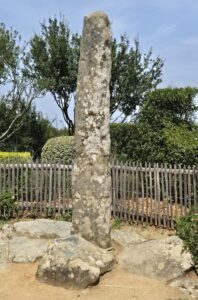
And there are more legends and make beliefs in this part of Brittany than there are in my writings! And that’s saying something! You need to know a bit about Korrigans. This is what I’ve discovered.
In Breton folklore, a Korrigan is a fairy or dwarf-like spirit. The word Korrigan means, in Breton, “small-dwarf”. It is closely related to the Cornish word Korrik which means gnome. I found 16 other names for these little people. Oh, and by the way … the term can include sirens and mermaids!
At a time when humans and Korrigans lived among each other, they were terrorised by giants. Humans and Korrigans joined forces and the humans lured the giants into a trap where they were destroyed by the Korrigans. Gargantua was one such giant who was struck down on Cape Fréhel. The numerous islets that are found in the sea are believed to be pieces of his body and the menhir at Fort La Latte, his raised finger protruding from the ground. No one seems to know which finger!
A little closer to the castle there’s a story board beside the path which tell the story of La Sirène de la Roche Goyon!
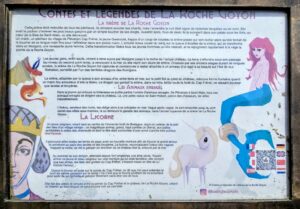
All the usual stuff about enchanting local seafarers and luring them to a watery grave. But on this occasion a local fisherman by the name of Morgans rescued a bunch of her captives.
Hunted by her former hostages for many years, the mermaid/sirène of La Roche Goyon was captured and condemned to remain attached to a heavy golden ring “equal to her beauty” on an island, watched over by a terrible dragon. You can clearly see the golden ring on her tail in the picture above. (I have since discovered that mermaid tail rings are popular pieces of jewelery – but normally worn on fingers not tails!)
The notice also talks of licornes. But everyone knows these are fictional creatures. So we won’t follow up on that rumour!
As we approached the castle, it suddenly became clear that there were going to be hundreds of steps in and around the castle.
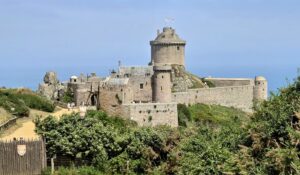
We decided that the gently sloping path was about as much as Glenda could cope with. So we left the place in the capable hands of the hoards of French tourists.
We are off to Cap Fréhel. The northwestern tip of our peninsula. It’s full and proper name is “The Grand Site of France Cap d’Erquy – Cap Fréhel”.
The cape with one and a half lighthouses (and too many tourists!).
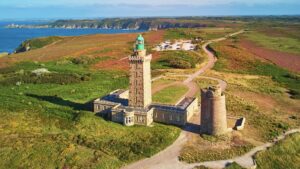
(Photo by DepositPhotos.)
The half lighthouse is actually the remains of the Vauban Tower dating from 1702 (or 1685 or 1694 depending on who you believe), it was originally developed as a part of a national defence scheme alongwith 11 other such structures. Later it was repurposed as a lighthouses. In fact it is considered the oldest lighthouse in Brittany. Originally the light was generated by a coal fire on the roof. Later it’s visibility was much improved by adding reflective mirrors.
The current lighthouse was built in 1950 following the destruction of the previous one by the Germans in 1944. It is now one of the five most powerful lighthouses in France, with a lantern that (allegedly) can be seen for 110 kilometers in ultra clear conditions. That’s because it has an extremely bright lantern situated over 100 m above sea level. (70+ m of clff and 33 m of lighthouse.) With145 steps to the top, it comes in the “too-energetic-for-us” category. We will leave that for more hardy folk! Deserted beaches are more our thing!
Continuing westward, we found ourselves on the “Plage de grèles d’en bas”, the” beach on strike below”. All mermaids have downed tools! But the tide is out. And when the tide’s out in this area, it’s really out!
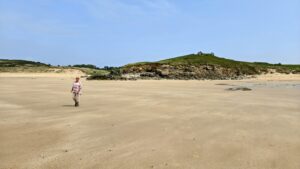
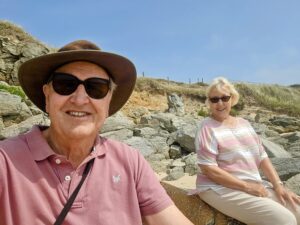
Resting at the far end of our walk, looking at the next two kms of the Bay of Crocs … which we won’t be walking today! One final port of call at Les Sables d’Or Les Pins. The location of my first ever foreign holiday, nearly 70 years ago. Not surprisingly, we didn’t locate the hotel in which my sister and I stayed with our parents and grandparents. But to be fair, we didn’t look too hard. It was time for home.
The next day was Wednesday 2 July. An auspicious day on the beaches of France. Today (and why choose a midweek day which is not the 1st of a month to do this?), a major change occurs. Well should occur. But current observations suggest that the French will ignore the new rule. As from today, smoking on public beaches is banned – for ever. Good luck with that Mr Macron! Glenda is dying to run a survey. We were off to the beaches of the Peninsula of Saint-Jacut-de-la-Mer. But it’s one of the only cool days we’ve had. Almost no one on the beaches!
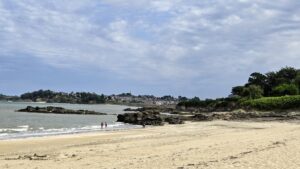
So, after a couple of beaches, the survey was called off! We shall have to wait till our next visit because tomorrow is our last day. Half of the caravans on our campsite deserted as we hit the boundary between the off-peak, largely retired, campers and the family holidaymakers. We too left the day before prices rocketed! By pure chance! The trip home was uneventful. No missed ferries, no jammed doors so no reversing off ferries and no traffic chaos in British country lanes. Boring!
So that’s the end of this saga, but before we go, I attach a letter which was sent to the editor of our newspaper. I hope Mr Wallace of Whitley Bay and the Telegraph don’t mind me reproducing it here! It made us laugh!
Great British cars
SIR – The rose-tinted recollections of elderly British vehicles (Letters, July 23) reminded me of when a neighbour collected his new British Leyland car.
That night, there was rain of biblical proportions. Next morning, he opened his car door and was met with a wave of water.
He immediately drove back to the garage, where the cause was swiftly identified: there was no seal on the bottom of the windscreen, so the rain could pour in. The mechanics undertook to resolve the problem while he waited.
Ten minutes later they returned the car. Their solution had been to drill several holes in its floor so that, although the rain would still come in, it would then drain out.
Ian Wallace
Whitley Bay, Northumberland
Dear John
For the exciting story and stunning photos!
It felt like we were briefly whisked away on a virtual holiday—while we were technically supposed to be working… But hey, a little daydreaming never hurt anyone, right?
Greetings
Stefan the Belgian