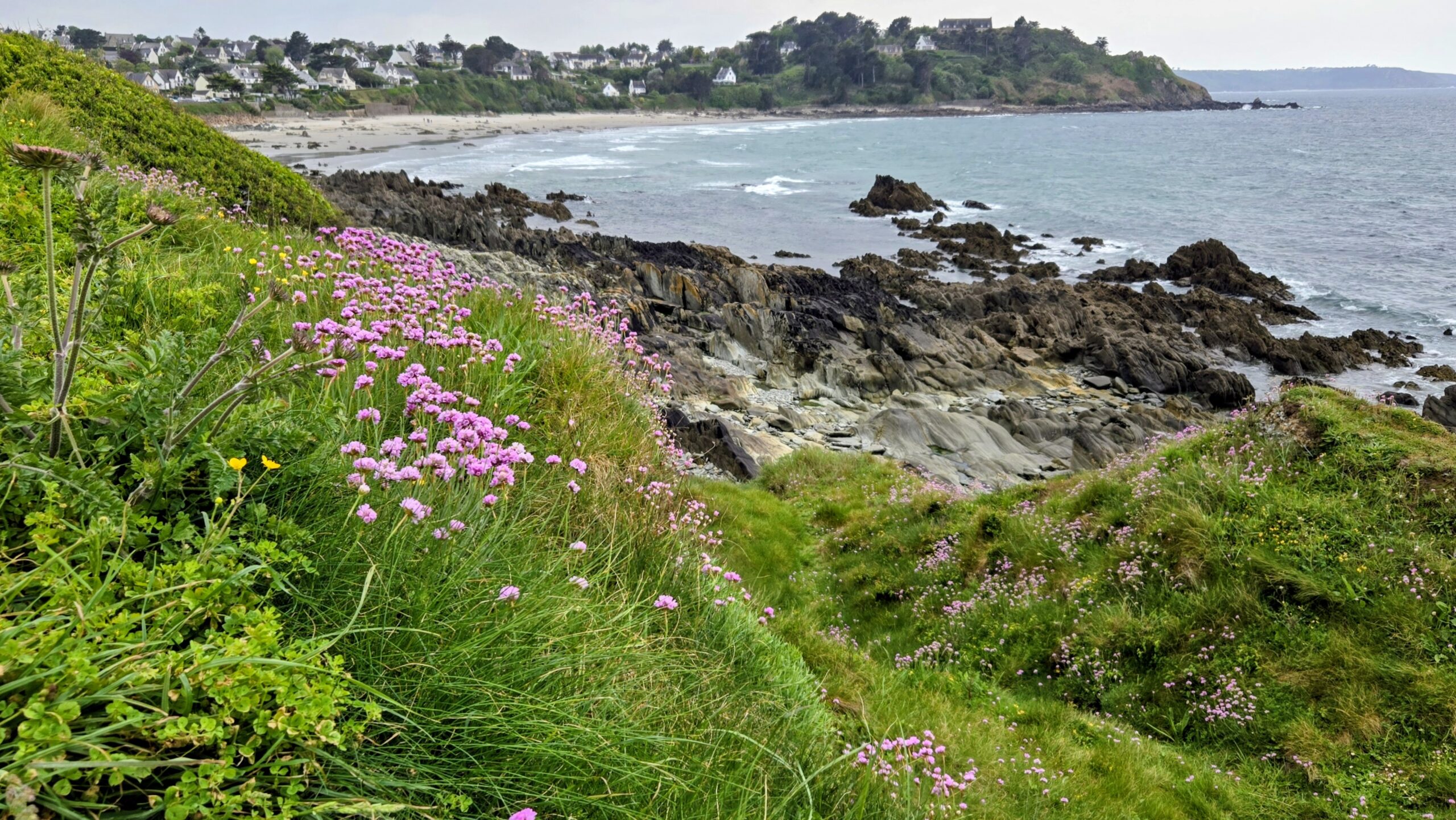
I don’t remember ever walking round Morlaix. It sits in a valley at the head of the Morlaix River. The river is crossed well north of town by a high-level viaduct carrying the N12, the main east-west route in the area. We have crossed this bridge many times and glimpsed Morlaix town and it’s marina from on high. But I think that’s as close as we have been, certainly for very many years.
Alongside the marina, there’s a lot of parking – both sides of the street! Free! But it’s on one of those “clever” French streets which have cycle paths painted on the road either side. But the road is only just wide enough for two lanes of cars without the cycle lanes. So cars have to drive half in and half out of the bits of road designated for two wheel transport. Well, we do only have two wheels in that zone, I suppose!
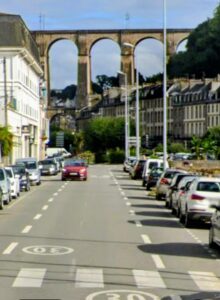
Confusing! We risk the parking, and hope that two buses or campervans don’t meet exactly next to us!
Morlaix, it turns out, is a delightful town. Nestled in a steep sided valley with lots of very old houses which are a lot bigger on the fourth floor than they are at street level. Each floor projects out above the one below.
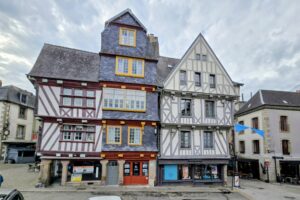
And they do like their murals around here!
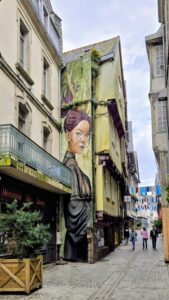

I think the message here is “Sod, you. I’ve just won the lottery!”
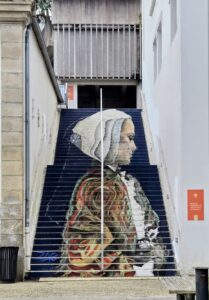
They even paint them on stairways. That must have given the artist a problem with perspective as well as continuity.
The town is dominated by a second viaduct. Right through the centre of town. This one carries the Paris to Brest railway on the top level and pedestrian traffic on the lower level.
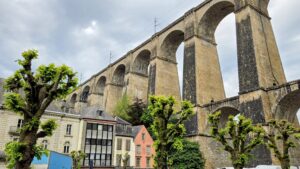
Completed in 1863, it was open for trains two years later. Taking into account the winter shutdowns, it took just 23 months to build it, or 406,105 worker days. It also came in 10% under budget! Just like HS2 … not!
At 290 metres long and 62 metres tall, it is made up of nine arches in the lower level and fourteen above. With an alleged total volume of some 100,000 m³, it must weigh over 250,000 tonnes. I hope they gave it good foundations! I never did get to walk over the lower pedestrian level.
On 29 January 1943, in an attempt to sever rail links to the strategically important city of Brest, the RAF lobbed 43 bombs at the viaduct. They managed to miss with 42 of them and the one that did hit, did only minor damage which was rapidly repaired.
A few hundred metres further up the road, we find the Hotel de Ville, the town hall. In front there is a lovely pedestrian area…
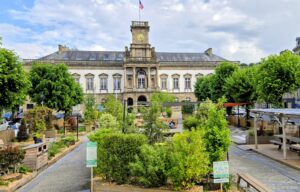
… but that area was less pleasant several times in history, most recently on 3 June 2018, just under eight years ago. This part of town was inundated in less than two hours …
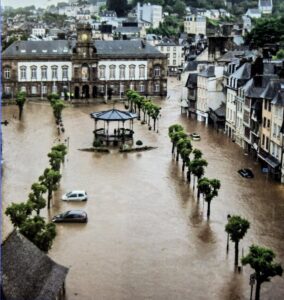
Anyway, time is running out, but we did admire the cakes in a shop on the right of the last photo …

… and pause for a late afternoon snackette of galletes and crèpes in Ma Doué. Very tasty, but we would have been standing in about a metre of water at both locations had we been there eight years ago!
Walking out of town, we diverted from the route back to the car. Glenda had seen some strangely attractive orange banners on the opposite bank of the River. The west bank. The Quai de Léon. These led us into a massive collection of buildings with internal courtyards of very generous proportions.
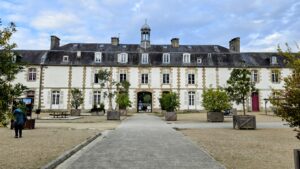
We didn’t really know what it was, but it had the feel of a collection of gentrified buildings with some sort of industrial background. There appears to be a close link with the adjacent department of the Université de Bretagne.
We now know that once it had been a huge tobacco factory. Now known affectionately as “La Manufacture”. A multitude of small spaces and large. There’s lot of historical guff about the site which includes, amongst a variety of other things, the Espace des Sciences – the science museum of Morlaix. We were so close (although probably too late), but didn’t know it was there!
Apparently, the museum houses an example of Foucault’s pendulum. A simple device named after French physicist Léon Foucault, conceived as an experiment to demonstrate the Earth’s rotation. A long and heavy pendulum is suspended from the high roof. When the circular area below the pendulum is monitored over an extended period of time, its plane of oscillation appears to change spontaneously as the Earth makes its 24-hourly rotation. This effect is greatest at the poles and diminishes with lower latitude until it no longer exists at the Earth’s equator.
Another useful fact to be learnt, stored away and probably forgotten in the fulness of time (or in my case two weeks)!
We visited the Quai de Léon twice more as we explored the surrounding countryside over the following few days. We kept forgetting that there is no lower crossing point of the Morlaix River other than Morlaix town centre!
To be continued as the icy blast from the North follows us on our travels!
Hello from Perth. All those lovely cakes ……all belong in a past life ..