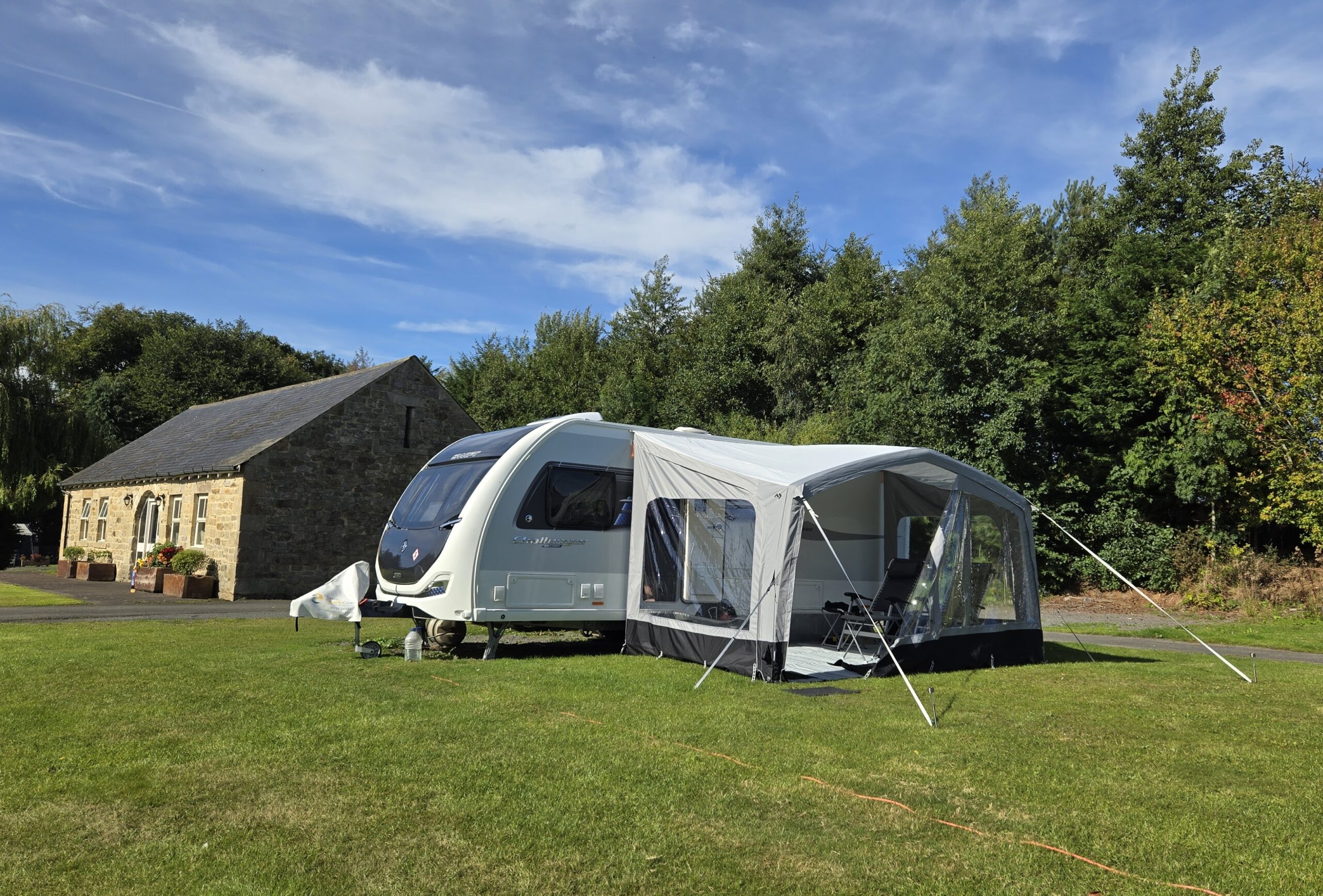
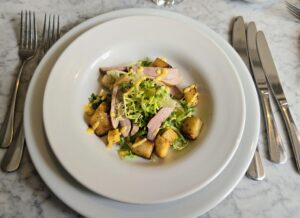
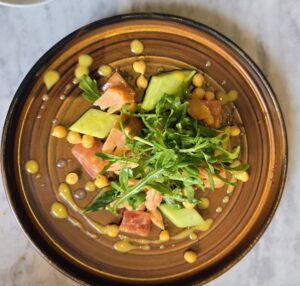
On our anniversary this year, we did make it to the Bouchon Bistrot in Hexham (not like last year!). An excellent “prix fixe” meal.
Hexham is another of these northern towns which attract visitors and businesses by providing free parking. Keeping the streets weed-free is another bonus. The southwest of England seems to have lost the plot on both counts. The lack of free (or at least reasonably priced) parking is killing off town centres. You would really think that someone in authority would have noticed by now!
There’s plenty of history about in Hexham. While the town is medieval – not Roman – there’s lots of Roman stuff nearby. Hadrian’s Wall is just a few miles north of the Tyne valley and we are camped very close to it. Possibly the largest historical remnant of Roman life in Northern Europe. It stretches 80 Roman miles from coast to coast. In modern money, the wall is actually only 73 miles long. The Roman mile was defined by Agrippa in BC 29 as 1000 paces (mille passum – hence the name “mile”). Each “pace” was two “steps” for a total of five “Roman feet”. While I couldn’t find any pictures of Romans with five feet, I did find this picture…

In town, Hexham Old Gaol…
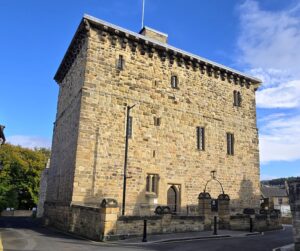
… is the earliest known, surviving, purpose-built prison in England. It was built in 1333 using stone nicked from the Corebridge Roman site just three miles away. Prisoners were kept mainly in the basement below ground level. The upper three floors were, apparently, occupied by the admin staff. Prisoners were housed here awaiting trial at the nearby Moot Hall on the edge of the market square …
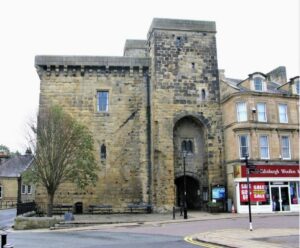
(Not my photo)
At the moment, the market square is being re-furbished and largely fenced off for the work.
… AND I discover that Hexham also has pants! However, in this town the word appears to apply interchangeably with drinking fountains for people as well at to drinking troughs for livestock. There are two “famous” pants in town The massive Temperley Memorial PANT in market square …
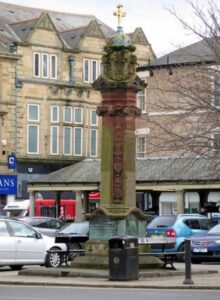
(Clearly not my photo, because this area is fenced off for restoration! Thank you Andrew Curtis.)
The second is the Glover’s Pant on Gilesgate. This one is linked to Hexham’s significant glove-making industry. The town became famous for its fine, coloured gloves, known as “Hexham Tans”. Using locally tanned hides and coloured with “Dutch Ochre”, these gloves were hand stitched. At the peak, in about 1820, more than 23,000 dozen pairs of gloves were produced annually and exported worldwide. That’s a lot of fingers and thumbs to be stitched – more than 2.7 million a year – possibly 10,000 per day. Clearly a major employer of the region.
It’s time for another relocation. We are off to a bran new site just south of Powburn. Thrunton Lowfield. This is the fourth tow of the caravan this trip and the third to be complicated by a major traffic accident. This one was north of Morpeth on the notoriously horrible stretch of the A1. Our sat nav was telling us all the way to turn off into the boondocks. But we’ve been there before and we’ve got the T-shirt! So we persist on the A1 until things start grinding to a halt. We just managed to scrape into the slip road for Jedburgh (the road we wanted!) before the car park extended another car’s length and totally closed off our exit. So that’s three accidents in four trips. Let’s hope prangs come in threes and that we remain clear for future drives.
Harry Vickers has opened a lovely little site a few months ago. Too recently to be in the guide books. So, for most of our stay, it was just us and Christine-from-Morpeth in her twee little Bare Foot caravanette.
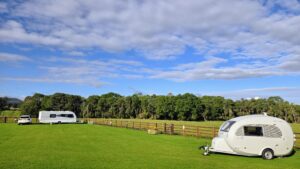
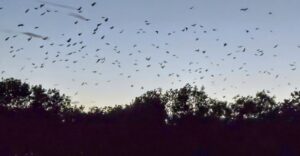
Very much little and large! Christine retired from a career in biochemistry in London and relocated to Morpeth. She supports Newcastle United – well, someone has to!!! The night she went to St James’ Park to watch the magpies play Barcelona, her team didn’t win – although they did come second. And while that was happening, we were treated to the twilight invasion of a murmurating flock of black birds, which may or may not have been jackdaws. In this country, I’ve only ever seen this behaviour in starlings and possibly the term is specific to that species. Anyway, it was spectacular as the birds came in to roost.
An early visit to Rothbury Golf Club for our non-member bacon bap breakfast with Yvonne was required. Followed by a walk along the bank of the River Coquet …
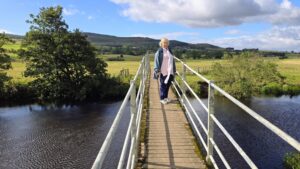
… and in the afternoon, another visit to Wallington Hall. One of our favourite National Trust properties.
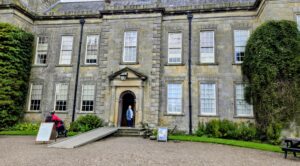
Glenda posing in the entrance as if she owns the place! And me in a reflective mood.
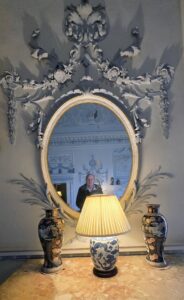
Upstairs we meet “Debbie” again. Famous for her acting skills pretending to carry a pile of pretend boxes containing pretend shoes for a pretend person pretending to be called John. (You will have to refer back to last year’s reporting of the event!)
Glenda’s brother is also called John. A very common, or should I say popular, name. There was one spectacular occasion many years ago when a group of us were travelling in Australia in a minibus. We came to a sign which said we were about to arrive at Johns River – a village in New South Wales, situated on the Stewarts River (to add to the confusion!) about 350 km north of Sydney. John, John, John, John, and Ron tumbled out of the bus for a photo in front of the sign. Taken by Ron – obviously! But I digress – that was over forty years ago!
Recently, brother John has been spending a lot of time in hospital in Bangkok, but is currently in Glasgow. We haven’t seen him for ages. We arrange to meet half way at East Fortune, near North Berwick. The home of Scotland’s National Museum of Flight. So, we are off abroad!
The museum consists of a number of hangars on a war-time airfield. These house a range of displays of old and very old planes. There’s one display of interactive exhibits to teach the fundamentals of aviation. Another cavernous building (only open for about 30 minutes a day) houses a lot of bits of planes in various states of repair. (Well, we are in the conservation and reconstruction department!)
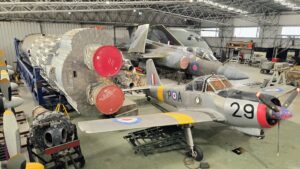
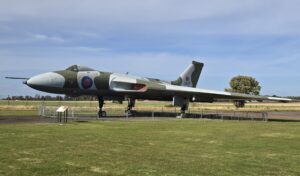
And there’s a Vulcan bomber parked outside …
But the best building – which we visited first – houses Scotland’s very own Concorde. Only seven British Concordes actually flew commercially. This one, identification sign G-BOAA, first flew in 1975, and flew the inaugural service to Bahrain in 1976.
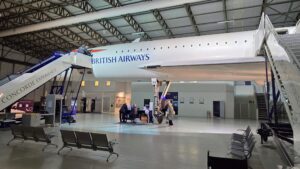
It’s impossible to get far enough away to get a photo of the whole plane!

Here the front wheels are being inspected. John was pointing out the flap which was designed to prevent objects being flung up and rupturing fuel tanks AND which, allegedly, had NOT been fitted to the French plane which crashed for that very reason.
The cockpit might have been state of the art when the planes were built half a century ago. But today it looks antiquated.

In modern planes, the information on all those analogue dials plus a similar number on the flight engineers panel is displayed on three large “i-pads”!
After the crash of the Air France flight 4590 in July 2000 all Concordes were grounded. G-BOAA never flew again. To get to its current home it was treated to a nose, wing and tail reduction job. Then towed through the streets from London Heathrow to a barge waiting in the Thames. Then by boat to Edinburgh and back on a truck to East Fortune.
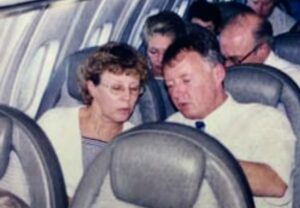
Brother John was a pilot and could occasionally get standby tickets. But he could only get them for himself, Glenda and their mum. Back in 2000, he managed to pick up three standby tickets to New York on Concorde. I wasn’t going to be left out, so I paid quite a bit of money for a full ticket. When we checked in, the plane was full. No standby seats! The three of them were going to have to take the next plane – a 747! But I WAS going supersonic! At the last minute, there were three no-shows – so we all got on. And arrived in NY before we left London!!! Fabulous. We think we actually flew on G-BOAA. The style of upholstery matches our old photos of the trip!
Then …
… and now …
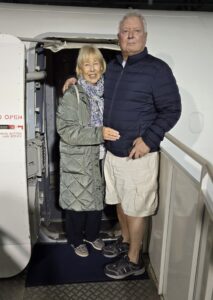
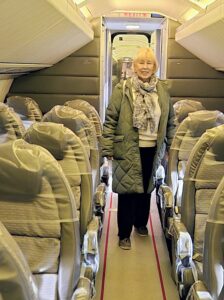
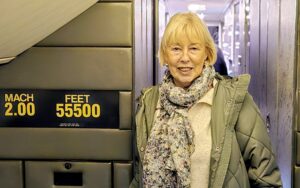
A transatlantic flight required the high-maintenance aircraft to gulp jet fuel at the rate of one ton per seat, and the average round-trip price was listed as $12,000. Fortunately, we only went one way on Concorde and didn’t pay anything like that!
A good day’s visit. We tried to find sensibly priced accommodation for the night in North Berwick and again in Dunbar. Not only was there no sensibly priced hotel room to be had, there were almost no rooms available at all. Competitors at a big golfing competition had, seemingly, mopped them all up. So we drove home!
The following day we lunched at the Cook and Barker at Newton-on-the-Moor and visited Walkworth afterwards.
The next day we were off – even further north. No accidents, but we did establish a new towing record that day!
Lovely write up again, and great to see you!!!