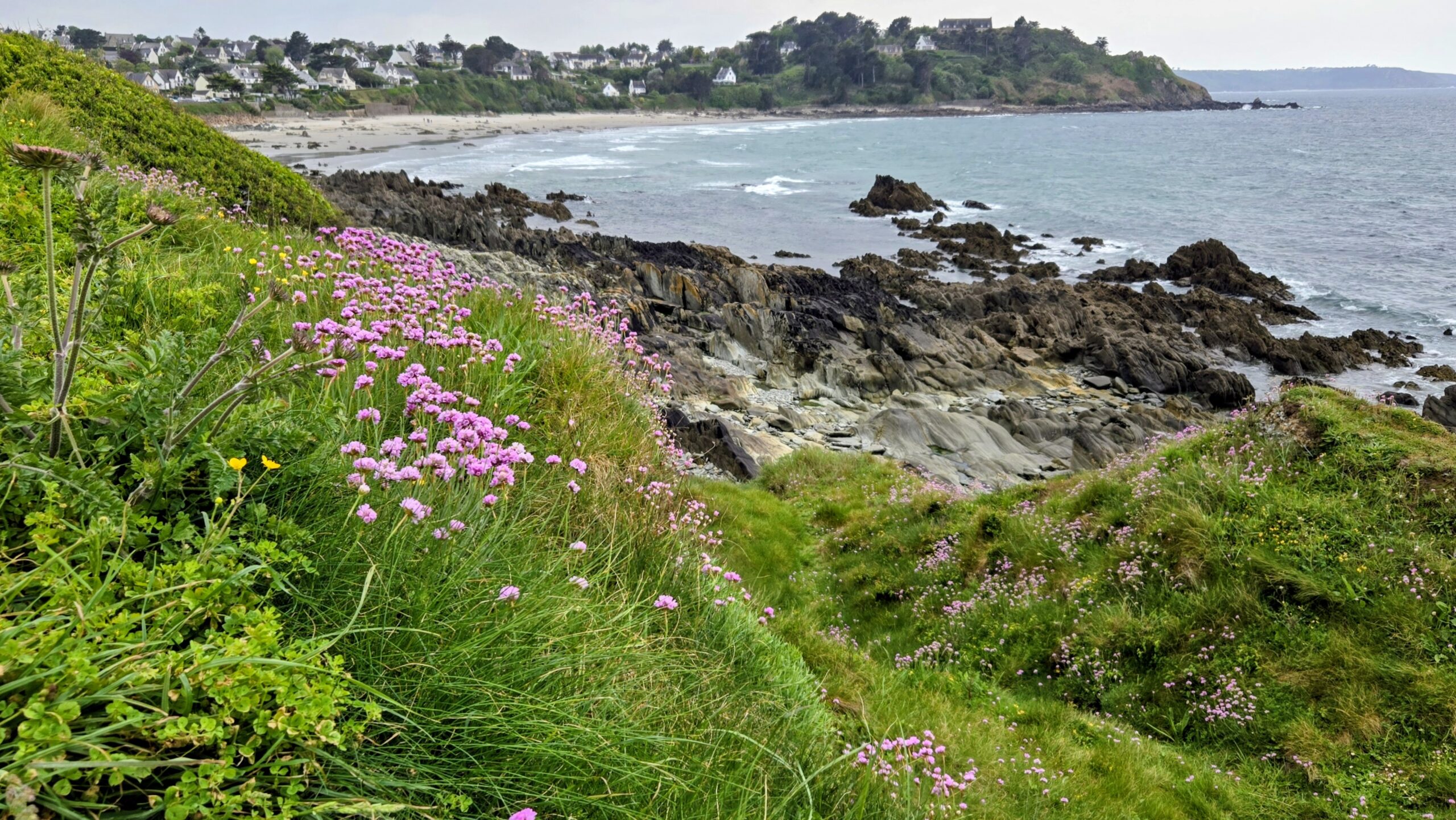
Arriving at Évron nice and early – before the reception opened even – we were given the same pitch as a French family who arrived 10 minutes after us. But the site was largely empty. We moved one place left and they moved one pitch right. Nothing against French families, but why park adjacent when it’s not necessary. They might snore! (And it’s just possible that we might, too!)
All pitches here are fully serviced. We have water piped in and waste drained out. Very refined, no dragging water around the place!
It’s very rural here. While walking five minutes from the site in one direction we have a massive Super U, five minutes the other way we were in narrow lanes of the “walking route of the Marais”. Not that there was much evidence of a marsh.
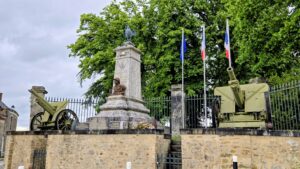
Heading south, we visited Sainte Suzanne, the location of the almost full campsite at which we decided not to stay. It’s a medieval town with a friendly greeting at the war memorial. Two German, WW II howitzers pointing at visitors.
But immediately opposite was a little coffee shack. A “guingette”, owned by Carol who used to run the hotel and restaurant in town. La cabane de Carol-Marie. A guingette is defined (amongst other things) as an open air café. As such, it is exempt from a lot of the planning beaurocracy for which French Mairies are famed. She does lovely filled baguettes and maybe fish and chips. And she doesn’t point artillery at customers!
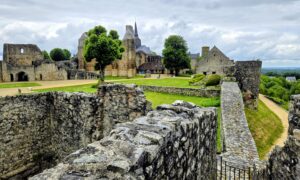
The castle has been updated with state of the art (at the time) defensive structures and embellishments. The signs around the place gave a clear explanation of the downward facing arrow slots, the curtain walls, the defended drawbridge and so on. At least I presume they were clear. The section on defence against ballistic missiles and drones seemed a bit confused – or was it my translation?
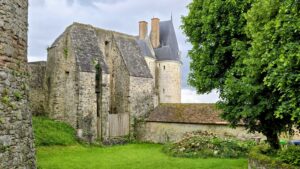
According to the local tourist office information, the “Salt Attic” is located in the Rue de Grenier à sel. (I’d lay money on the street being named after the attic rather than the other way round!) This is a former salt store dating back to 1725. It has retained its “three-lock door”. It can only be opened if the three locks are simultaneously unlocked. The three most important notables of the town, each holding a different key, had to be present to enter this building. Maybe prison gates in the UK need this security system to reduce the number of dangerous prisoners being “accidentally” released into the community.
All the inhabitants of Sainte-Suzanne and the 25 surrounding parishes were required to come and collect their salt supplies and had to pay a tax called the gabelle. In Sainte-Suzanne, the gabelle was a very high tax compared to other regions, such as Brittany, which was exempt. This tax was thus locally considered unfair, and salt smugglers, called “false salt makers,” appeared on the scene. The salt granary was looted by the population in 1790. Of course they didn’t know then just how dangerous salt actually is. Hypertension, heart disease, strokes, insanity…
Please pass on the salt, Glenda!
On the other hand, as we wandered aimlessly round town, we passed hundreds of rose bushes, all in flower.
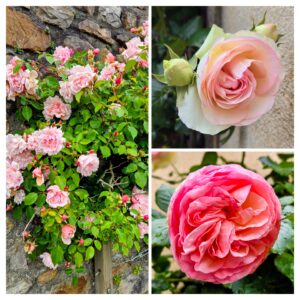
We heard somewhere we were on the “route of the roses”. This maybe true. However, I can find no information from Mr Google to confirm this.
So that’s the local medieval town inspected. Now Jublains, a Roman settlement a few miles northwest of camp. To be fair, as far as we are concerned, not a patch on Sainte Suzanne. The massive church in town is the snappily named, Eglise Saint-Gervais-et-Saint-Proteus (we will come back to these enormous edifices later). It appears to have been built on top of ancient Roman thermal baths. Press an insignificant button on the wall of an excavated area and an indoors son et lumiere show lights up. I’m sure the commentary would have been interestingly descriptive as the various parts of the exposed baths were illuminated in turn. You will have to take their word for that.
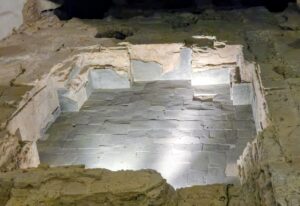
The baths were discovered in 1870 when the community wanted to build a “modern” church on the site of the previous medieval one. There is also a museum of Roman antiquities, but we weren’t in the mood. We needed a country walk.
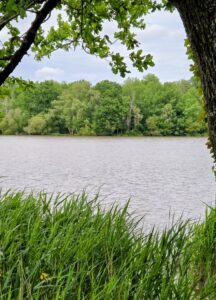
Half way home, we stopped at the Étang de Gué de Sel. A promising 3.3 km walk around the lake. It started as predicted – a walk beside the lake.
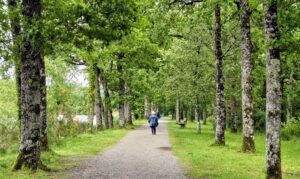
But soon changed into a walk through a partially submerged forest.
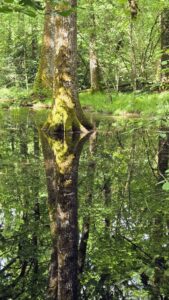
If we did the walk again, we would do the first section there and back followed by the last (also lake-side) sector and back. The same distance as one full circum-navigation. Unless, of course, the temperature reached 33°C. But when does that happen in Northern France?
It’s time for a new location. Sully-sur-Loire here we come.
Beautiful countryside. Safe travels for your continuing journey . Day 100 here in a fortnight.June 14. All continuing to go well.