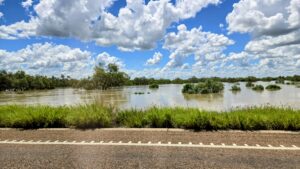
We left the Sunshine Coast in pouring rain. We arrived in Longreach, some 1,300 km northeast of Brisbane, still raining. While not exactly a desert, the area around Longreach is normally red, dry and dusty. As a result of heavy rain a few weeks ago, the country is green, green, green. The ground is saturated, the grass is growing wildly and the hire car company warned us not to risk any deviation from the tarmac roads. The gravel tracks are strictly for 4WD vehicles. The cleaning surcharge for sticky mud removal is astronomical. The tow-out costs even more so!
Longreach airport is a delight. One check-in desk, one departure lounge, one arrivals “hall” and one luggage carousel. (There were two toilets though!)
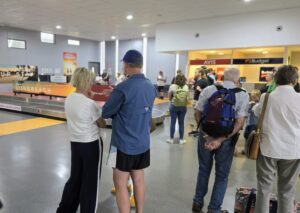
While we waited patiently for our bags to be transported the 30 metres from the plane to the “terminal”, we noticed that all the passengers seemed to know everyone else (except us, of course). “You staying in town tonight?” “Yes, too far to travel to the homestead this afternoon.” “Will we be seeing you in the Tavern tonight, then?” “Yes, probably! I see Pete, Fred and the boys are here as well …”
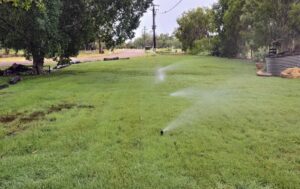
Ron, our host from Saltbush Retreat pitched up in his minibus to transport us the 500 metres to our accommodation. In the rain. But the front lawn sprinklers were adding a new dimension of wetness to the already waterlogged grass out front.
Jeff and Laurel, our friends from Melbourne, were arriving later that afternoon by rail. But the train was delayed a bit and it was early evening by the time they joined us. It transpired that the train only just made it through floods between Emerald and Ifracombe. It got in, but was then marooned there for the entire time of our stay. After the floods, the tracks would have had to be inspected and any ballast displaced would have to be replaced. I guess there would be a bit of beaurocracy involved in having the tracks recertifed as train-worthy. It’s not impossible that the train is still parked at Longreach station!
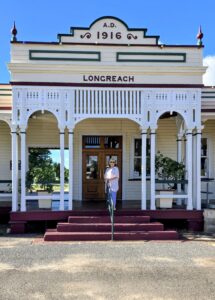
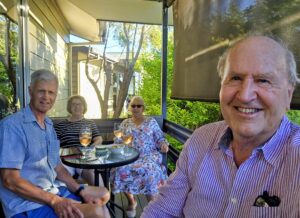
The rain stopped during the first evening and the weather turned beautiful for the rest of our stay. Here we are relaxing on our deck, once we were all in residence!
In town, we had a chat with a group of locals all dressed in white, waiting for their billie to boil!
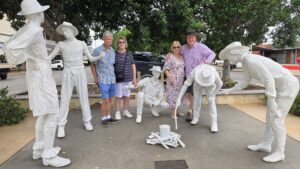
“The Drovers” (Around the Campfire): A group of white sculptures was originally created for Brisbane’s World Expo ’88. After being displayed in Brisbane for 30 years, they were relocated to Eagle Street in Longreach in 2018.
On the subject of street names in town … They are all named after birds. Streets running east-west (parallel to the Thomson River) are named after water birds, while north-south streets are named after “land” birds. Not sure there are any diagonal streets! But they might be called penguins if there are any!
We were advised that if we wanted to visit Winton, the next town on the road heading NW, we should go sooner rather than later. This was because of heavy rain at Aramac and Muttaburra some 150 kms to the northeast was causing the Thomson River to flood as the excess water flowed downstream. The river flows under the Landsborough Highway, the road to Winton, and the floods were expected to arrive in a few days time. The Winton road will be closed when this happens as the river will flow OVER the road! You have to understand that Longreach is served by just three tarmac roads. Southwest to Stonehenge, East to Ilfracombe and Northwest to Winton.
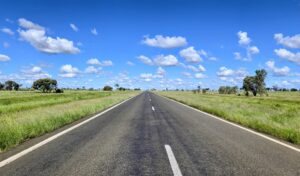
The road to Winton (ca 200 kms) can be described as “fairly straight”. Oh, and “fairly quiet!” There is NOTHING along this stretch of tarmac apart from three un-manned rest areas. When we visited, I drove the return leg. I didn’t pass another vehicle going our way and was only passed by one ute returning to Longreach. “Fairly quiet!” And there were only about six moderate bends and three or four slopey bits where the elevation changed by maybe ten metres up or down. I was going to count these features accurately, but they were so far apart that I kept forgetting the score!
However, we did share the space immediately above the tarmac with a million huge, grass-hoppery things. I guess they are all making hay (and babies) while the grass is so luxurious! I managed to get a photo of one in flight – by pure chance …
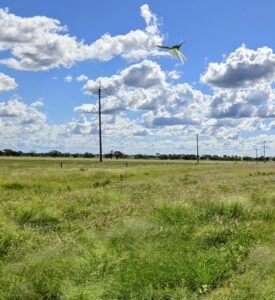
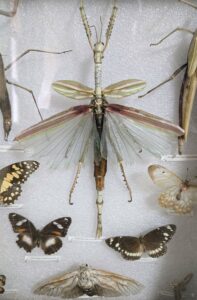
The front of our hire car was absolutely plastered with the blighters by the time we got home. A bit of scrubbing was required to make sure we weren’t going to be hit by Avis’s clean-up fee!
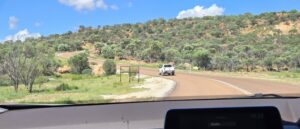
Just south of Winton, a side road to the left heads for what is known locally as a “jump-up”. A stunning 75-metre-high mesa, home to the world-renowned Australian Age of Dinosaurs Museum.
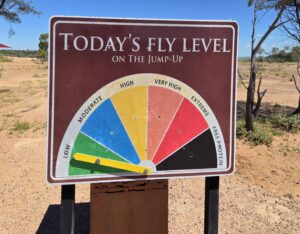
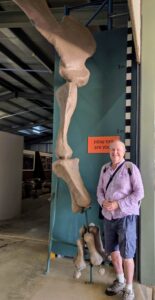
An interesting take on fire warning signs – and lots of dinosaur bones. One impressive back leg gives a bit of a clue as to the size of it’s long-dead owner.
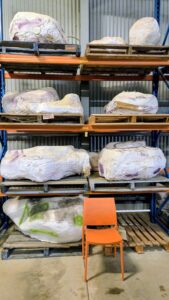
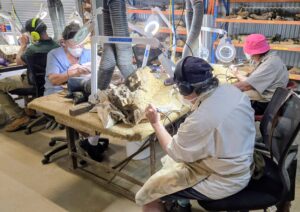
When a specimen is found, it is carefully wrapped in a plaster-soaked bandage and extracted with some surrounding rock. It’s stored in it’s cocoon, sometimes for years, until the team is ready to extract the fossil. The volunteers use tiny hand-held “pneumatic drills” to carefully remove all traces of inert rock. The decision of where the boundary lies between “rocky rock” and “fossilly rock” is the tricky bit. The excavators have to go very slowly. The lady in the foreground below took a year to clean one side of a bone … and now she’s working on the other side! They may call that dedication, but there are a few other words that spring to my mind!
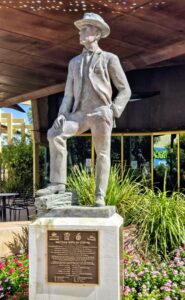
We didn’t have time to do the whole tour because we had another museum to visit. The Waltzing Matilda Museum in town. A. B. “Banjo” Paterson stands guard outside the front door celebrating his 1895 best seller! Although he was born in Orange and died in Sydney, Banjo wrote the famous ballad while living at Winton.
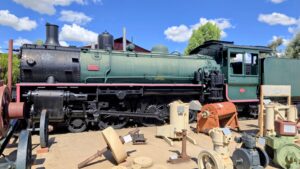
The place is full of memorabilia about the song and it’s writer … plus stacks of more general museum “stuff”. Like this old locomotive.
They have also got a resident brown snake in the back yard somewhere, but it didn’t show itself while we were there. Maybe it’s time to move on while it’s not on view!
We didn’t visit, but about 60 km to the east of town there is what has been described as “a roughly circular crustal anomaly with a diameter of ca 160 kms that might well be an impact structure.” This is thought, by some, to be the site of an asteroid or comet strike. Calculations indicate that such an impact would have released energy equivalent to 650 million Hiroshima atom bombs (roughly 40 zettajoules). To put that into context, the immense heat absorbed annually from the sun by the Earth’s oceans is approximately 20 ZJ. (Incidentally, the zettajoule is a genuine unit of measurement!)
I only mention this because this is the second such structure we have come across. Do you remember the astrobleme we tripped over at Rochechouart (about 80 km NE of Angoulême) in June 2024? That’s probably another of the same thing! Lots more zettathingies expended!
Time for home! Perhaps the water level will be rising on the outskirts of Longreach. Yep, it is! The pastures beside the Thomson are starting to go under.
Now, for the two main attractions in Longreach. First the Australian Stockman’s Hall of Fame. This is located about 200 metres from our hotel. The futuristic domed structure is guarded by a 15 foot tall statue of a typical Stockman.
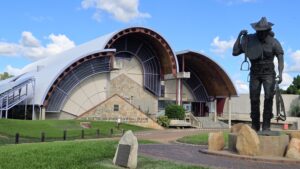
This museum is best described as fabulous or, possibly, extremely fabulous! There are so many stories recorded by old drovers, station owners, shearers, wandering traders and assorted outback dwellers. We are visiting outside the typical tourist season, but the morning we were there, there were at least six other paying guests. The guide welcoming us described his morning’s situation as being “rushed off his feet.” ” Flat-out busy!” Get real, young man!
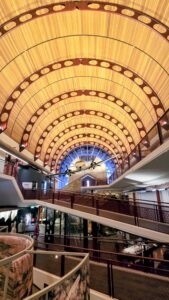
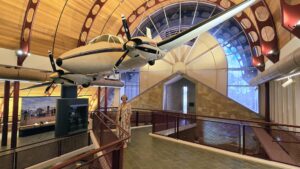
The domed main hall is home to loads of stuff including one flying doctor plane, a travelling supermarket …
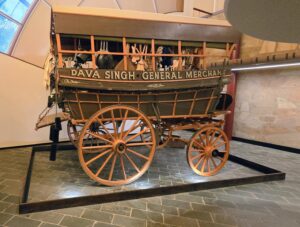
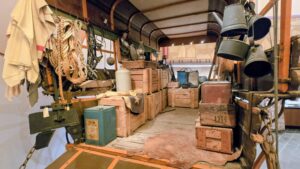
…and examples of old slab cottages as well as a modern-day-drover’s micro helicopter.
On the audio devices provided, there were countless stories of day to day life in the outback and of the life of the drovers on the trails to markets. The longest official stock route is the Canning Route which is recognized as the longest historic stock route in the world, stretching roughly 1,850 km (1,150 miles) from Halls Creek to Wiluna in Western Australia. However, the longest recorded cattle drive took place in 1883-1886, Charles and William MacDonald drove cattle roughly 5,600 kilometres (3,480 miles) from New South Wales to the Kimberley region of Western Australia. Over two years on the move from watering hole to watering hole! It must have been a phenomenally hard life. There were some very self-reliant and determined people, back in the day. Their experiences and life stories live on in this excellent museum. One definitely not to be missed!
I need a sit down now! Actually, I’ve just had one in Stuart James’ luxury limo (Babbacombe Cars) driving home from Heathrow – that’s where a large part of this chapter has been written – only a month in arrears!
The other main attraction in town is the Qantas Founders Museum, but that’s going to have to wait!
On my Bucket List!