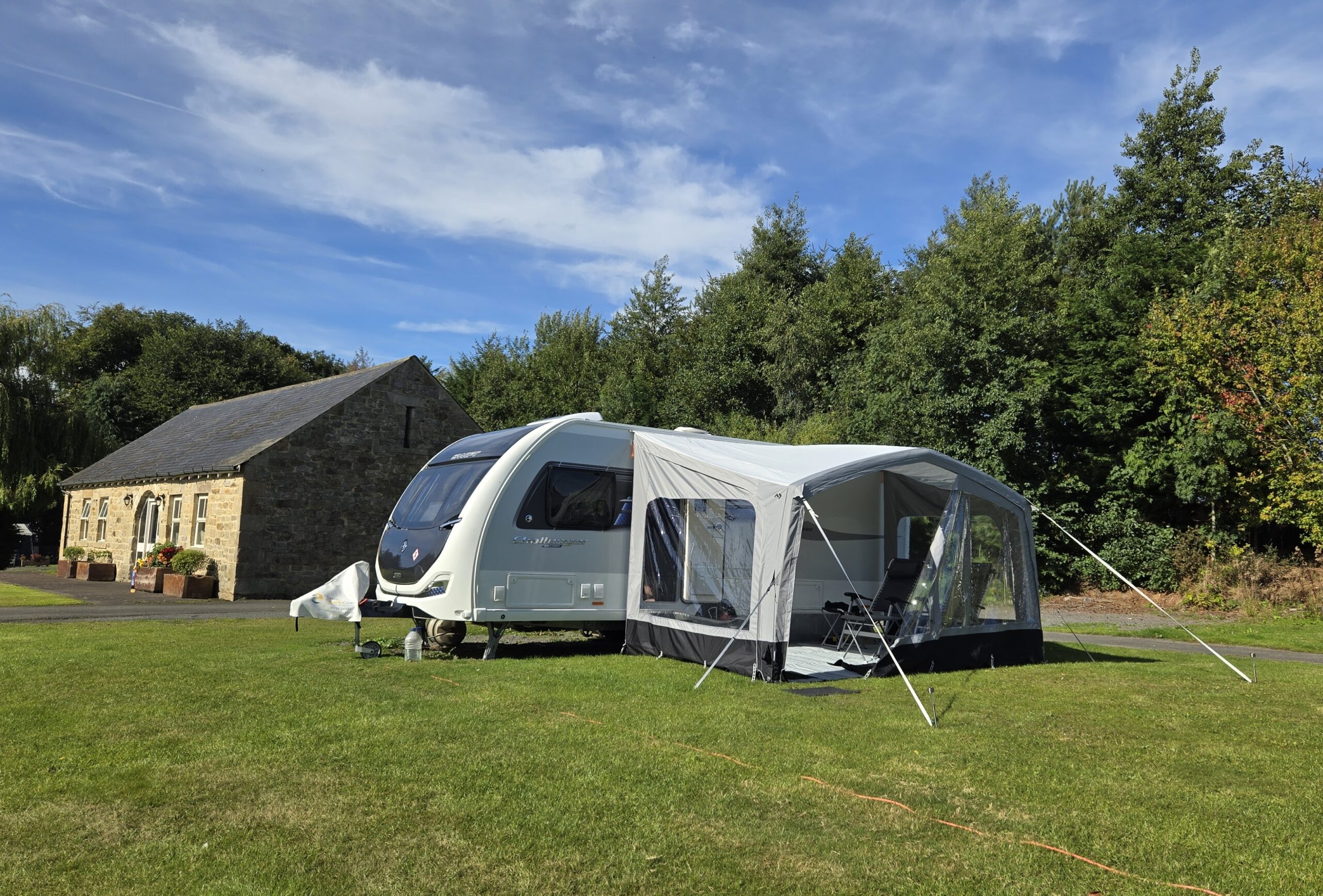
So, who IS Bob? Later!
First we have to visit Cragside before we leave Northumberland. Never mind the house. Straight to Nelly’s Moss for a walk round the reservoirs. And we are being shadowed!
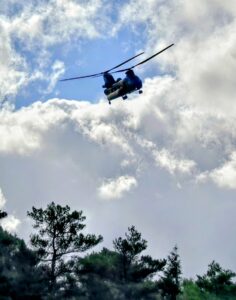
… and because we waved at him, he came back for another, even lower pass!

We waved again. He’s now submerged in Nelly’s Moss! This year the reservoir levels, at least in the bottom lake, appeared lower than usual. You can just make out the rotor blades of the sunken Chinook!
We had to visit Hexham again. A small matter of a blue jersey to collect! 120 miles round trip … just saying!
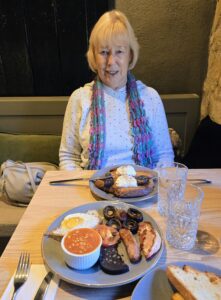
But now it’s nearly time to move to Dumfries and Galloway. There’s just time for breakfast at the new Running Fox which shares premises with the Plough Inn in Powburn. “Coffee shop” in the day and pub in the evening.
We called at the local garage-cum-convenience store to make sure we are fully fuelled. We pulled up beside a large “ute” (to use Aussie-speak) and a bloke hopped out of his truck and went to buy some cheese and stuff for his lunch. He looked vaguely familiar. Just very vaguely, mind you. I met him inside and, I don’t know what made me say it, but … “Are you Bob?” “Yes”, he says. “Bob Foster-Jones? I say” “Yes”, he says! “I last met you in 1969 – 56 years ago, at our graduation ceremony!” I say. “Good grief”, he says (or something similar!). The moral of this story is that it’s always worth checking! Sadly, we are off and he’s busy, not even time for a cup of tea – so I gave him my contact details and we parted company. I’m still not sure he really knew who he had been talking to!
Back to reality… We are faced with a choice of routes. Via Kelso and Hawick, the shorter “northern” route through Scotland with at least three sets of roadworks and narrow roads – or the long, boring, main road way via Newcastle, Hexham (again) and Gretna! Google maps, the sat nav and Glenda all suggested going north. I chose south. Chicken! But we got there – passing a sign for the “Devil’s Porridge Museum” – as you do!
It transpires that the name “Devil’s Porridge” was coined by Sir Arthur Conan Doyle in 1916 to describe the dangerous mixture of nitroglycerin and gun cotton used to make cordite, an explosive for World War I shells. He witnessed women at the “HM Factory Gretna” mixing the unstable, lumpy paste in large pots and thought it looked like a “devilish” version of porridge. The term stuck, becoming a slang name for the explosive and the name of the museum dedicated to the factory and its 12,000 (predominantly female) workers. The promotional information invites us to make our own cordite! I think we will give that a skip and move on to our pitch at Partridge Cottage about five miles north of Dumfries.
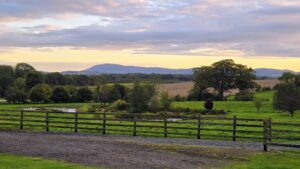
That’s Criffel (570 m) in the far distance – and that was about the best view we got from the caravan. It rained and drizzled a lot for four days!
We were recommended to visit Caerlaverock Castle, a moated triangular castle first built in the 13th century. It is located on the southern coast of Scotland, seven miles south of Dumfries. It was originally built to control trade in early times.
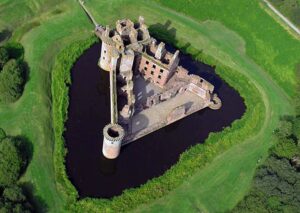
(Clearly, not my photo!)
However, our trips all ended up going further west, so we never did see this unusual castle. But we did stop at New Abbey on the opposite shores of the Nith Estuary. We hauled into the New Abbey Tearooms and were met on the entrance door by signs of excellence handed out by “Egon Ronay”. This will be good!
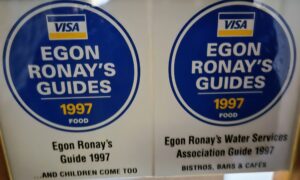
Closer examination, however, revealed that these awards were made in 1997 – nearly 30 years ago!!! Great to be proud of ancient accolades! The soup and loaded tortillas were very acceptable, nonetheless!
The Sweetheart Abbey of New Abbey, is actually not as new as it was when built – 750 years ago.
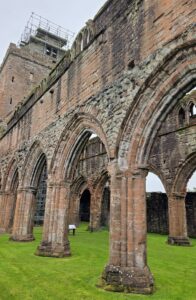
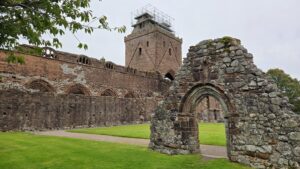
In 1268, Lord John Balliol died. His grieving widow, Lady Dervorguilla of Galloway, had his embalmed heart placed in an ivory casket. She is said to have carried it with her everywhere. She undertook many charitable acts in her late husband’s memory. These included founding the Cistercian abbey of Dulce Cor (Latin for ‘Sweet Heart’) in 1273.
(For the record, Lord John was installed as the King of Scots, by England’s King Edward. He also founded Balliol College in Oxford.)
Travelling further south we found Carsethorne near the mouth of the River Nith …
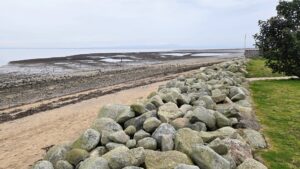
The Nith was the location of a lot of visits to the area by ICI’s survey team (in my youth), using a hovercraft, investigating the environmental impacts of two ICI factories near Dumfries. One of these was a Nobel division’s explosives factory. The design of the HM Factory Gretna (of porridge fame) was based on that of the Nobel factories in Dumfries and Ardrossan on the Clyde Sea Area.
Later, we were the only visitors at Colvend Golf Club for coffee. The first hole was more or less straight up a steep hill. It looked a VERY energetic sort of course to me. And we saw signs saying wildlife cameras had been installed somewhere up the top. We questioned everybody on site (well, the only person on site, actually). What wonderful animals were they looking for? Wallabies, leopards or pheasants? No, it was to deter vandals who were wrecking the watering system. I guess it’s that sort of place! Anyway Mr Golf Club (who happened to have the popular name, John) recommended a visit to Rockcliffe. One of the best places in the area to live! Apparently!
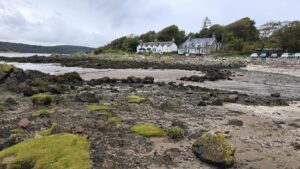
Well there were five parking places and a truly optimistic icecream van there! The view out to sea was pretty …
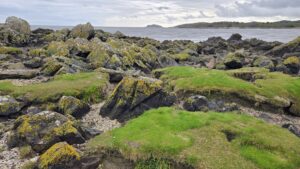
… and the icecream was a welcome treat! But we have serious business to attend to. Lunch at a place recommended by our campsite hosts. Its a rather nice café at the Outdoor Activity Centre in a tiny place called Laggan. But when we get there, we find it shut. Closed up, tight as … well, definitely locked!
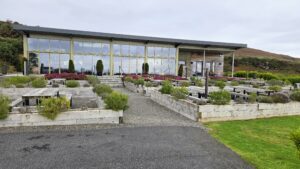
But it still has a fab view!
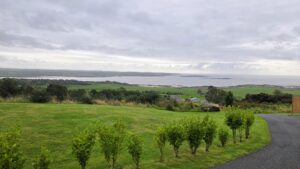
The entire estate was deee-ser-ted. We eventually broke into an office building at the entrance and found two employees. They explained that the “Go Outdoors” centre changed its name to “Gather” in 2020. And eventually closed to walk-in customers last year. All tourist info in this area needs up-dating!
The rather genteel village with the descriptive name of “Gatehouse of Fleet” has coffee shops galore – well, at least one that was open! The “Iron Brew”.
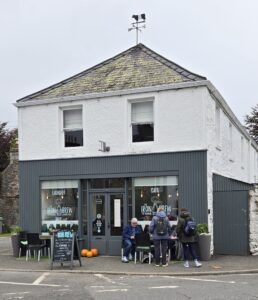
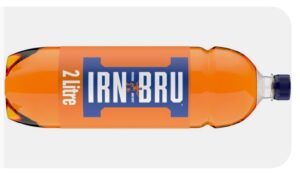
Rather a clever double play on words. It was originally opened as a laundry and pressing business (hence “Iron”). Now a café (hence “Brew”) with the laundry business running from a separate location. And “Iron Brew” evokes the national soft drink of Scotland – “Irn Bru”:
Opposite the café is the rather fine, 75 foot tall clock tower.
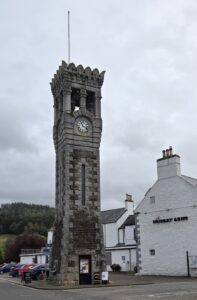
It was built in 1871 at a cost of £300 plus £160 for the four-faced clock. That’s a little over the current cost of 120 cappucini at today’s prices. And we’ve probably drunk that many during our current eight week trip – but there’s no clock tower built to commemorate our achievement!
Later that day, as the local mist elevated to a steady drizzle, we found Kirkudbright (known properly as Kuh-COO-bree – but I do prefer Glenda’s rendition!). We have been looking for a National Trust for Scotland at which to exercise our English membership cards. There are only three of these in this neck of the woods. And Broughton House, (home of the artist Edward Atkinson Hornel) happens to be here in town – but closed today! We rang the bell anyway and were met by the curator. Seeing our saturated disappointment, she invited us in for a quick personalised tour of the house.
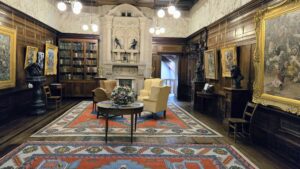
It turned out that her daughter had recently been married at the “only-occasionally-open” Gather at Laggan. Apparently it was very expensive – including the £1 per slice fee just for cutting the cake! Personally, I’d take a pre-sliced cake to that venue!
The town is quite a substantial fishing port. The fleet contributes significantly to the local economy, with the annual landing of 7,000 to 8,000 tons of shellfish.
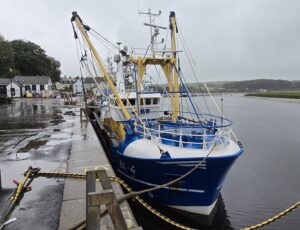
Castle Douglas was another drab, wet and forlorn sort of place. There is an air of despond about the place. We were told that it was a “minimum wage ” area. The graffiti on this wall sort of said it all.
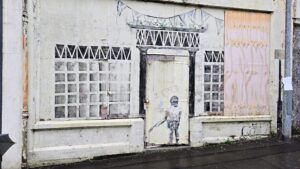
I think this part of Scotland needs good weather to bring out the scenic beauty of the coast and countryside.
We have to be in Glasgow in two weeks time, but we decide to move to the Lake District in the meantime.
… but guess what happened as we tried to leave Scotland!
Castle Douglas sounds so impressive.