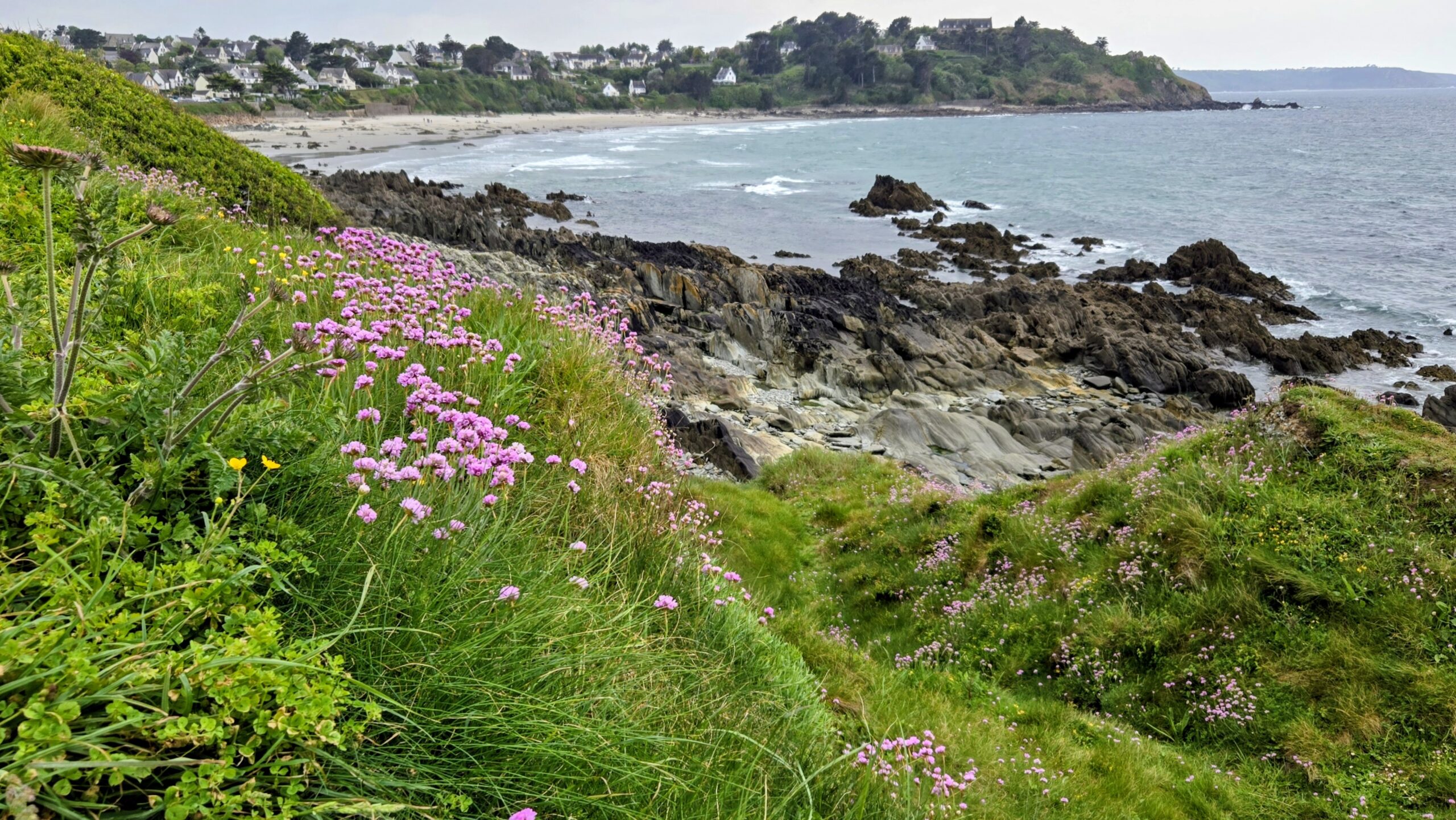
So, after an unplanned five day delay waiting for our noveaux essuie-glaces to arrive from Strasbourg, we were now free to roam! But first we need to make sure the wipers work in the rain.
So, one final tour of the coastal region to the north of Morlaix was needed. We managed to secure a delicious lunch at Carantec Golf Club. They normally only take reservations, but one look at our universal non-membership cards and they squeezed us in. The menu is determined by a famous, local chef, Nicolas Carro, who runs a very up-market restaurant in L’Hôtel de Carantec, just up the road. We couldn’t get a sniff of a table in the very posh hotel, but his food at the golf course was, I’m sure, equally delicious and less than half the price!
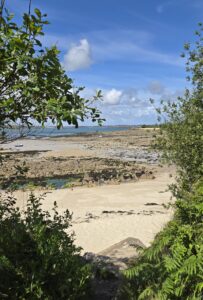
The beach at Térénez looking back at Roscoff where we had landed a week ago!
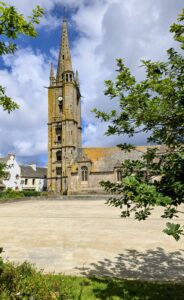
Even the tiny villages hereabouts have the huge churches with elaborate spires. This is Plougasnou’s offering.
A little further to the east we discover the museum at Guimaec. We had passed it twice before without realising it’s significance. (That’s what comes of reading about places after visiting them! However, my chief editor says she knew about the secret beach.)
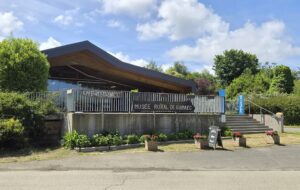
If my translation of French historic documents is accurate, a tiny hidden beach near here saw a lot of secret activity. In early 1944, seven separate missions under code names “Easement”, “Septimus” and “Scarf” were launched. These daring actions saw a total of 27 Resistance agents and the odd downed RAF pilot evacuated to safety on dark moonless nights. (Of course, if my translation was less than accurate, it may have just been beach parties organised by the local youths.)
We have been having a little difficulty with navigation in the area. Some roads trasmogrify into footpaths with little or no warning. Others marked as dead ends can turn out to be completely navigable. (Best not to ask how we know that!) There were some roads we needed to take to save miles of re-routing that were inconveniently marked as “for residents only”! Best not to ask about them either!
However, the biggest problem was the similarity of place names. A huge number of village names start with “Plou” (for example: Plouzoc’h, Plougasnou, Plouégat, Plouigneau, Plourin, Plougonvin, Plougras, and Plounéour. All within 20 minutes of our campsite.) “Where are we going today? Plousomething?” “Yep!”
Research showed that “Plou” is a Breton-language toponym meaning “community” or “parish” (from the Latin “plebs”).
While we are talking about useful facts to await the right question in the right pub quiz, here’s another little gem. I have to admit, I never knew this…
The Bretons of Bretagne, or Breizh, as they call their native land, are the last vestiges of the Celtic Britons that migrated from Great Britain and gave their name to this northwest section of France. They speak both their traditional language, Breton or Brezhoneg as well as French. (Again, my clever editor says she knew all about this too!)
We found a lovely little bar/tabac-cum-convenience-store at Saint Efflam, near Plestin. The beach is huge, massive even at low tide. We have walked sections of the beach earlier in our stay. Excellent coffee and chat with a couple of ex-pats who have been living in Plestin for 17 years. Apparently this establishment is by far the best coffee stop in the area.
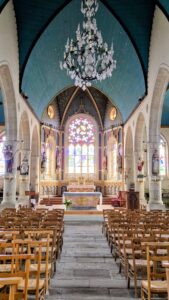
You may have noticed the blue skies in the photos above. No rain, so our wipers were not tried in anger … until we ventured south of our campsite to the village of Plougonven. Here, the massive church had an enthusiastic allocation of seating for over 400 worshippers …
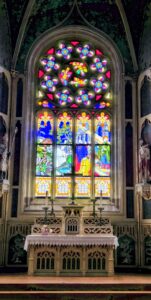
… and a rather colourful stained glass window.
Outside, in front of gathering storm clouds there was a spectacular, monumental, carved stone calvary. Dated 1554, this was allegedly the first of seven similar monuments scattered around Brittany. These massive, elaborate sculptures all date back to the 16th and 17th centuries and are notable for their intricate carvings and historical representation of biblical scenes. Each calvary is unique, having been designed and carved by different artisans of the region, and often added to by others.
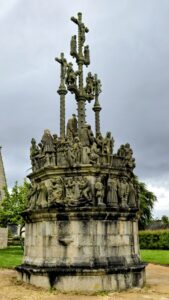
(There are thousands of less ornate calvaries all over France, by the way. Common as muck!)
Behind the church was a small, rectangular park-like enclosure with a pool and a fountain said to have been carved by the local monks. “Man playing the lute”.
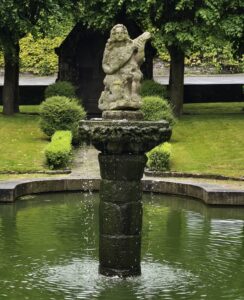
Nearby signs seem to indicate that this tiny park has been designated as a Geopark. Really??? Oh, my mistake! The Geopark Armorique is massive. We are in it, but it extends all the way to the Crozon Peninsula, south of Brest and covers almost 169,000 hectares! This is one of just 213 such geoparks world-wide. Our micro park is a tiny portion of the real McCoy.
… and it rained … and the wipers worked flawlessly (as they should).
Flushed with excitement, we decided to head east. The trifids had been severely bashed back by the big truck delivering the new sanitaires. I had promised to manoevre the caravan through the zig-zag corridor on the mover, but in the end we agreed that I would just drive out (slowly). We barely touched the hedges and definitely not the big rock with which the truck had had his damagingly-too-close encounter! Piece of cake, really. Albeit a thin slice!
We had earmarked a small site on the edge of Sainte Suzanne to the east of Laval. They confirmed they had a pitch. But it was the last space on the site. Potentially, the least favourite spot. Adjacent to the toilets. Hemmed in by trees and bushes or slap bang next to the all-night disco hall. So we made a decision. We would dither. Dither as we drove. This would give us the option of just pitching up and doing a drive-by inspection. We did have an alternative in mind a few miles further north at Évron. When option 1 messaged to say they needed to know as they had other enquiries. We un-dithered and headed straight for option 2 at Évron.
Good decision. Every pitch on site was fully serviced. Electricity, water and waste immediately to hand. So no hauling water in barrels or emptying waste water. And most pitches had a view out over grassy banks. Plenty of space! Result.
I have one more factlet on which to end this episode. I used the term “real McCoy” earlier. “The real McCoy” was the inventor Elijah McCoy, born in Canada in 1844. He had many different inventions including an ironing board and a lawn sprinkler. Other companies copied his devices, but these never worked as well as Elijah’s so people would say, “I want a … , and make sure it’s a real McCoy.”
The things I have learnt and am learning following your travels …… I have always wondered where the saying ” the real McCoy ” came from. Now I know.
H