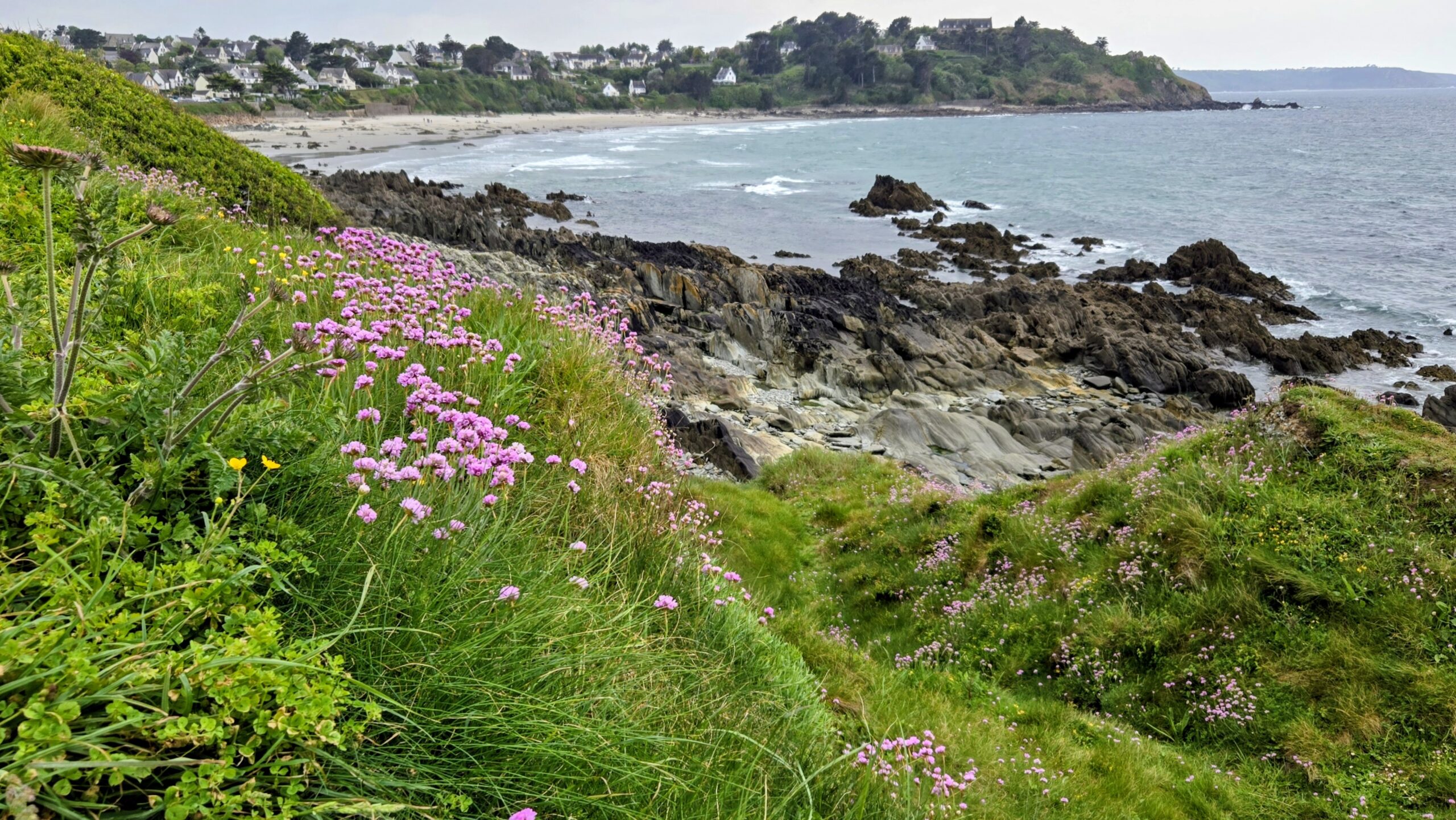
Navigating the northern ring road round Le Mans, we came to one particularly dodgy and complicated roundabout. Going really slowly trying to change lanes, we brought traffic to a total standstill. Well, there were five options and we needed option three. But this option immediately divided. We needed 3b and came off the roundabout in one lane too far to the right heading for 3a. No doubt dead easy if you know what you are doing! We need a refreshing coffee! Urgently! And less than 15 kms later, we stumbled on a restaurant at a roundabout. The Auberge du Narais. We circled the roundabout fifteen times trying to work out how to get into their massive car park without leaving useful bits of caravan scattered all over the road.
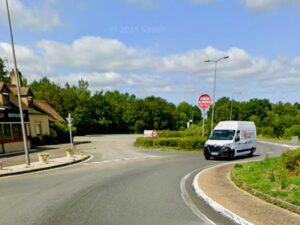
I know that looks easy from this angle, but it’s quite a tight and slow turn for a caravan and NOBODY is expecting such a manouvre. Most normal customers turn in before the roundabout at the far end of the carpark! Once in, we swung around and parked ready to drive straight out later.
An excellent coffee break turned into lunch stop 15 minutes later when the Auberge officially opened for the meal of the day. But when we came to leave we found that Les Frogs had blocked us in. Probably as a joke. But it backfired when madame la proprietaire demanded they leave their meals and move their cars out of our way. We left quickly!
Later, as we approached Vendôme (I think it was Vendôme but it might have been Fréteval), we missed a sign for the ring road. Well, to be fair we did see it, but not until we had passed the junction. But Madam Sat-nav had us going through the old town anyway. Let’s just say, the ring road would have been a MUCH, MUCH better route. The significant point about Vendome (and Fréteval) is that they are on the River Loir. Le Loir not La Loire! Always a surprise!
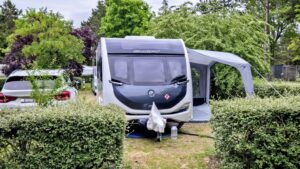
Camping Le Jardin de Sully is located, confusingly, at Saint-Père-sur-Loire. Sully-sur-Loire is on the other side of the river. We grabbed a corner pitch with a view of the river. Well, a glimpse anyway. It’s mainly German campers here, and one British couple immediately next door, but they declined to even acknowledge us. So there was no chit chat on that front! Still, awning up and settle down.
The first expedition was to Gien. The campsite we stayed at last time we were here (many years ago) is just visible on the far bank of the River as viewed over the roofs of town.
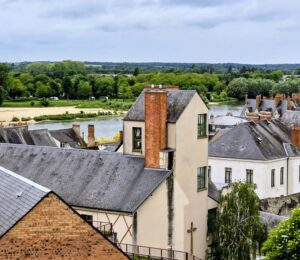
We did visit the site, but it was much developed since we stayed there. Loads of fixed chalets have been planted and appear to be breeding. Our recollection was of a big field with lots of trees and camping wherever we wanted. Now pitches have numbers – heaven forbid! To be fair, had we arrived here with our caravan, we would have stayed.
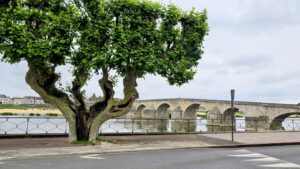
The bridge over the Loire with an “e” at Gien.
One of the big attractions in town was the porcelain factory and boutique. We managed cleverly not to have found it last time. This time, carelessly, I drove right past the place. So now we know how to get there. All that was needed was a 180° turn on the main road and we were ready to shop!
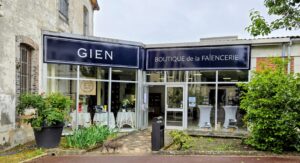
The porcelain here is pretty famous (or so I have been told!). And the top quality, hand-painted stuff is the real deal. I lost count of the zeroes in the price of the biggest pieces.
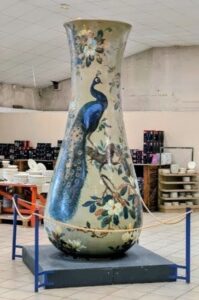
I will admit they were fabulous – but were never going to fit in the caravan … for several reasons, of which the size, weight and fragility of the items were just three! However, Glenda did manage to find a screened off area where plates were more attractively priced. We now own six delightful, un-painted plates (very suitable for small cakes and pastries). They are carefully wrapped and stashed in the car in the compartment where a spare wheel might have been stored in days gone by.
Over the bridge by our current campsite, we visited Sully-sur-Loire. Lunch was taken at the busiest tavern in town, Le P’tit Sully. Excellent. But now we need a 25 mile walk to deal with the calories consumed. Sadly, they don’t do miles here, so instead, we settled for a three km route round the lake behind the chateau.
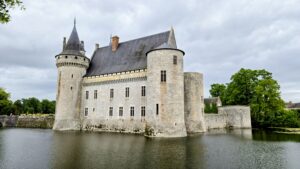
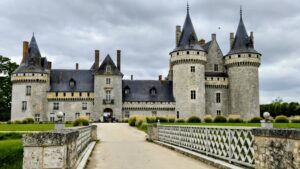
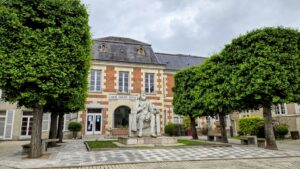
Then to make our walk more calorie-consuming we walked through the town, past the Centre Françoise Kuypers. Françoise was a doctor, a chemist and a benefactor, but the statue out front is clearly not of her. Clearly male. In fact it’s of Maximilien de Béthune, the first Duke of Sully who, as Superintendent of the Nation’s Finances, was France’s answer to the UK’s “Rachel-From-Accounts”. (Sorry Maximilien, I really shouldn’t compare you with Rachel. I’m sure you properly understood the Nation’s finances!)
We extended our walk downstream on the riverside path until we were opposite our home on wheels. Then back to the car. That was our three miles for the day!
Travelling around the French countryside, we have gradually worked out what constitutes a French village or small town. They all have a number of things in common. For example they all have at least two dynamically unstabilising speed bumps. One at each end of town. Often with dozens of the blighters in between, and they are all denoted 30 kph speed zones. All villages have additional traffic calming measures where the road width is dramatically reduced with priority randomly allocated to traffic coming or going. They all have no significant, moving, local traffic. All the town’s cars are parked randomly on pavements, junctions and pedestrian crossings and look as though they’ve been immobile for decades. All villages have at least one bar/tabac, almost always closed. By law, no residents are allowed to be seen by visitors during daylight hours. All towns appear to be ghost towns, but compulsorally have a magnificent hotel de ville (town hall) with flags and well maintained flower beds, a mairie, a notaries office and a central market area. There used to be a legally binding requirement for all communes to have a boulangerie or, at the very least, a depot de pain from which the ghostly residents could obtain their twice daily fix of baguettes. (But this no longer applies.) There is almost always a free-to-use public loo and a DAE point – a defibrillator. And lastly, they all have a super-massive church! Some examples follow.
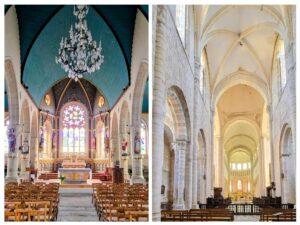
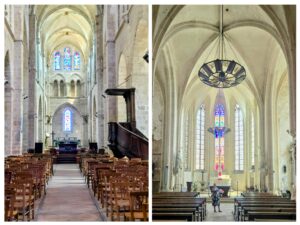
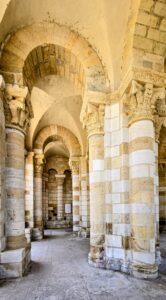
Churches in Guerlesquin, St Benôit-sur-Loire, Lorris, and Sully-la-Tour respectively. I think the catholic church has about five basic designs and ALL of them have seating capacity for 200 to 600 worshippers. I’ve counted! Where these people would come from nowadays, I haven’t a clue. I find it hard to believe that they were ever filled to capacity.
Apparently, there are 100,000 churches and chapels in France. And VERY few would be classed as anything but large!
You might wonder why I’ve been researching village churches so determinedly on this trip. The answer lies in the laws of thermodynamics (or at least, in my interpretation of them!). It’s blinking hot outside. A church is a massive object with a huge volume of air enclosed. Let’s just say that churches retain the coolth imparted to them when they were first built. They remain beautifully cold inside during heatwaves!
“Glenda let’s go check out the church in the next village!”
Is this the start of a belated post graduate study and Thesis. Smily face…… don’t know how to isert a drawn smilly face.
Have caught up with your French blog at last- all these towns and villages we’re never likely to visit, so it’s just as well you do it for us, with very detailed descriptions of historical information and facts.