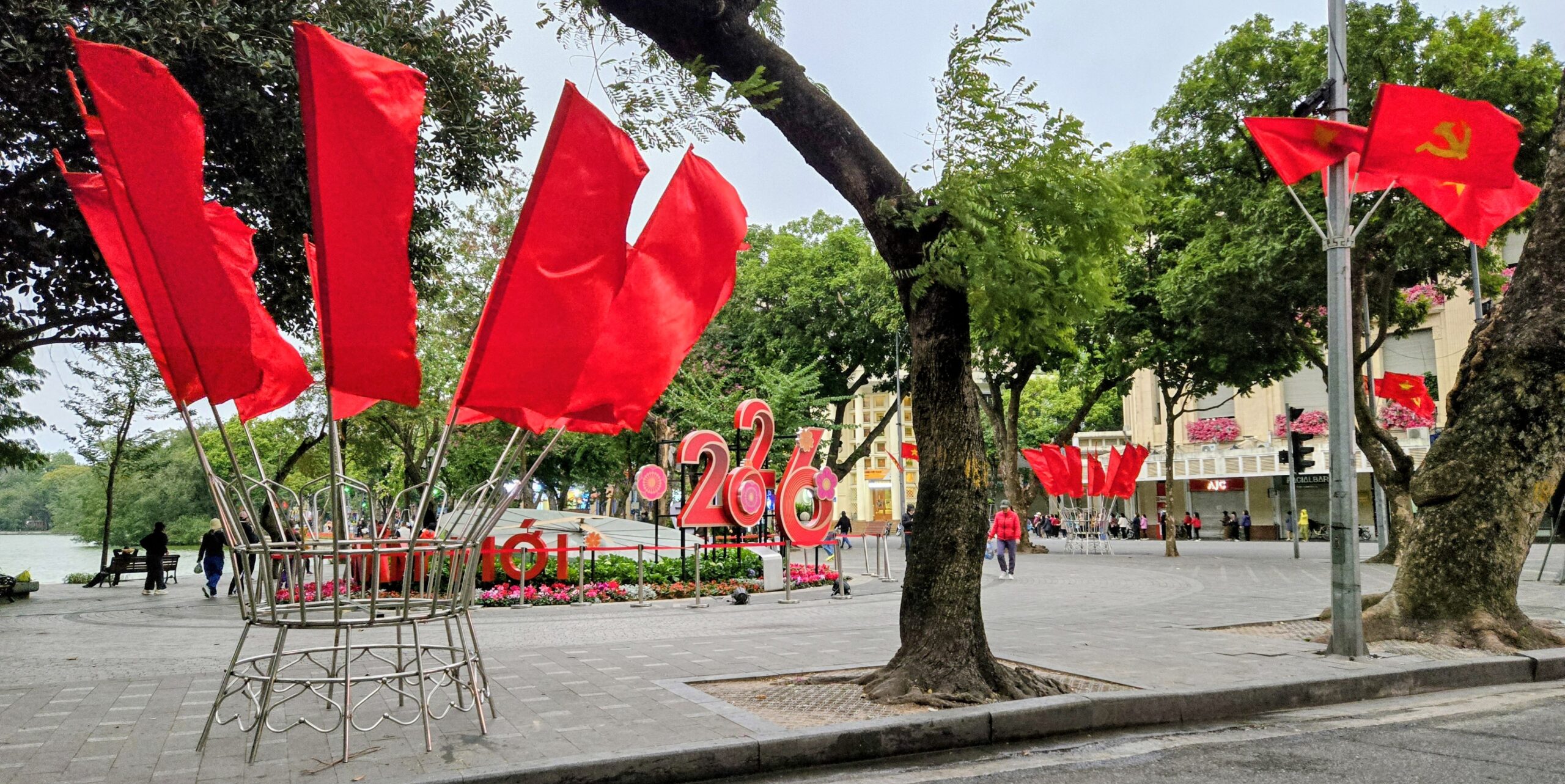
Arriving in Ho Chi Minh, we flew into basically the centre of the city. But are we in the right place?
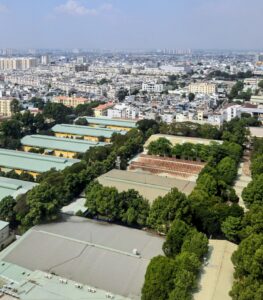
Despite the name change in 1976, “Saigon” remains in common use. It was known as the “Pearl of the Far East” during the French colonial period. Whatever it’s called, it is Vietnam’s largest city, with a population of some nine million people. (Hanoi has just over eight million citizens.)
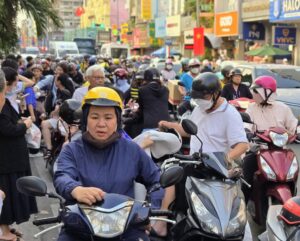
It is estimated that there are around 7.5 million motorbikes in Saigon. Approximately 25% of the population is aged under 16 years, so there are only about 6.75 million people of legal driving age in the city. This means that there are more bikes than riders! REALLY! In addition, around 1.5 million motorbikes enter Ho Chi Minh City every day. Commuters from the surrounding “countryside”!
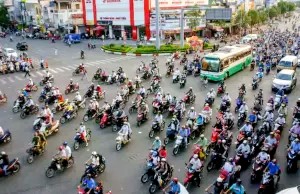
Vietnam’s traffic fatality rates are the second-highest in South East Asia (depending on whose figures you believe!). For the record, we witnessed just two moving traffic accidents. One, where a car had run into the back of another and the second where a motorbike had done the same thing to another car. In the first case the two drivers were talking animatedly to each other about the weather and the price of biscuits. In the latter case, the car driver was taking dozens of pictures of the scene while the lady motorcyclist lay motionless in the gutter. I was actively encouraged to NOT get involved… And I always do as I’m told!
Like most countries, at traffic lights green means “go” and red means “stop”. In Ho Chi Minh, when they spot an amber light, everyone seems to think they should actually drive faster rather than slow down. However, in Vietnam, deliberately running an amber light is a serious misdemeanor! Equal to jumping a red light!
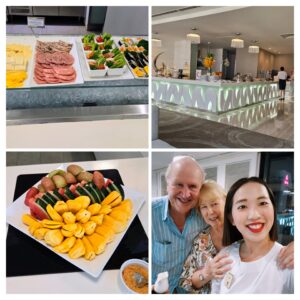
We stayed at the Novotel, close to the Re-unification Palace (aka The Independence Palace) as well as the famous Post Office and Cathedral. We occupied rooms on the 17th floor. These gave us access to the “club lounge”. Drinks and nibbles all day, and quite a substantial buffet from 5.30 pm. It would be quite possible to stay here and not wander further affield than the 20th floor!
Part of the buffet and our very friendly host, Huỳnh Nhú (we called her “New”).
We did wander out and found a couple of restaurants locally with an interestingly varied menu – to suit all our tastes (although we never did actually find chicken fried rice for Glenda)! We came to what appeared to be an Instagram location, with people photographing themselves outside a restaurant complex (Mặn Mòi). We waited till all the self-important people had grabbed their “Insta-moment” – then we took ours!
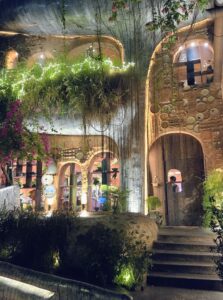
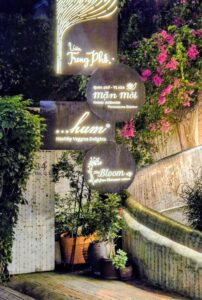
We also passed the War Remnants Museum. All locked up for the night, but some big remnants still very much on display!
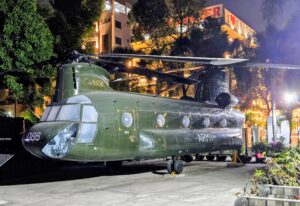
This is a Bell UH-1 Iroquois “Huey” utility helicopter, which served as the primary workhorse for the US Army during the Vietnam War when about 15,000 were made.
The “Huey” helicopter nickname originates from the phonetic pronunciation of its original Army designation, HU-1 (Helicopter, Utility), which was used when it was introduced in the late 1950s.
Next day we went “walkabout” in the city. One of the things Linda wanted us to experience was the famous money changing operation near the Post Office. But first, Book Street! Strictly speaking Nguyen Van Binh. Immediately adjacent to the Post Office and leading straight towards the Notre-Dame Cathedral, it is a charming, tree-lined pedestrian street. A hub for book lovers featuring numerous stalls with Vietnamese and English books, cafes and, according to my AI assistant, “a quiet, cultural atmosphere perfect for relaxing”. AI really needs to pay the place a visit. There’s very little opportunity for relaxation in our limited experience! The street was packed!
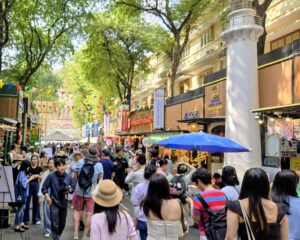
Turn left at the end of book alley, and there we are at the front of the Post Office.
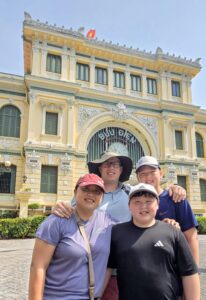
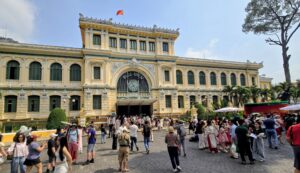
Last time we were here, we met a gentleman well into his eighties. He sat in the back under the domed roof and wrote letters and translated messages for locals who couldn’t read or write. Sadly, although he is well remembered, he is no longer with us. Now there is no one to help. Maybe it was a dying need!
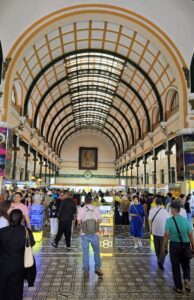
There are a few small “government”, trading outlets in the post office foyer. One of these is now short of a silver necklace – but only after a second visit! (Incidentally, in this context, “government” means “no bargaining”.)
Now, back to money changing! Banks are for normal, reserved, sensible people. Street trading is for the enthusiasts! Some jewellery shops are known for their good exchange rates. Ha Tam is one such place.
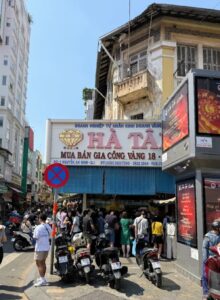
There are about five queues approaching the windows where exchanges occur. Although, which queue you are in is not clear until you are next in line. We have $120 US from a trip years ago. They need to be exchanged! The procedure is to hand over the notes through small openings in the windows. They count and sort the money. The count is checked by a second person. Calculations are made and printed. Checked again by a third person. The deal is offered and, if accepted, zillions of Dong are dished out. I have to say that in the crush, I did feel a little exposed. However, the guy in front and beside me was taking a long time, but he was changing $10,000 US in $100 notes! His loot was carefully inspected note by note. Apparently, pristine notes get a better rate than dodgy, scruffy ones. The stash went through the automatic note counter twice (by different people). His transaction was checked by three staff members, but he just accepted a plastic bag with what must have been well north of a quarter of a trillion dong! I guess if a mugger was going to choose him or me, I’d be fairly safe! While waiting in “line”, the shop took two large suitcase-sized deliveries of local currency. It all seemed very normal and safe!
Back to reality!? Coffee is the most popular drink in Vietnam. In Ho Chi Minh City, it is more than a beverage, it’s a lifestyle. It’s served in a variety of ways in hundreds of coffee shops all around the city but the most popular way to drink it is served cold with condensed milk. Like this, it’s usually thick enough to “eat” with a spoon.
On Nguyen Hue “walking street”, we came face to face with the “Cafe Apartments”. A famous, ancient, nine story apartment block which has been converted into a collection of dozens of unique cafes and boutiques.
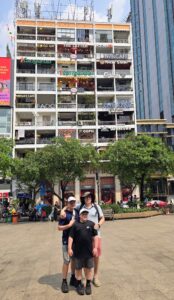
Access is apparently hard to find (we didn’t try!). The elevator costs 5000 dong but the concrete stairs are free to use. There are still some residential apartments – mainly on the higher floors. On the top floor, allegedly, there is one of these “lived-in” spaces where the resident serves coffee in her living room.
I didn’t know, but there is a guideline for peak coffee freshness. The 15-15-15 coffee rule. Green beans are best used within 15 months of harvest, roasted beans within 15 days of roasting, and ground coffee should be brewed within 15 minutes to capture flavour before it rapidly degrades due to oxidation.
The “town hall” retains it’s French-inspired grandeur mixing well with surrounding high-rise buildings. Built over 125 years ago, I wouldn’t be surprised if it outlasts the surrounding steel and glass edifices! (On that thought, a little research online tells me that skyscrapers are generally designed with a 50-100 year lifespan!)
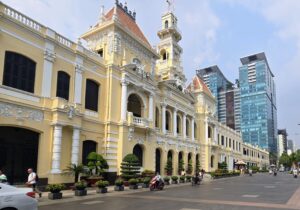
Originally built to serve as the city’s administrative centre during French colonial rule, it was renamed the Saigon City Hall in 1954 and became the People’s Committee Building in 1975.
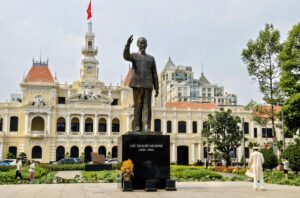
Viewed from the pedestrian precinct in front of the building, Ho Chi Minh makes an appearance!
Next stop, The Independence or Re-unification Palace. Outside …
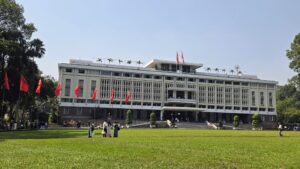
… and in …
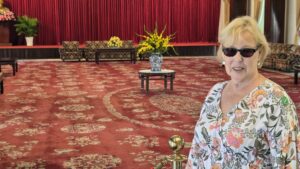
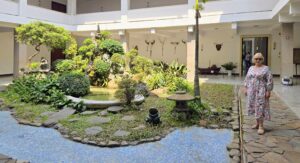
Every home should have one of these on the roof!
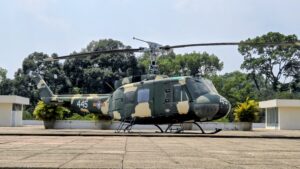
And, maybe, a couple of these on the front lawn!
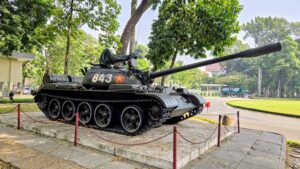
On 30 April 1975, North Vietnamese tanks came (literally) through the front gate of what was then the South Vietnamese Presidential Palace. This brought to an end almost twenty years of conflict in the country.
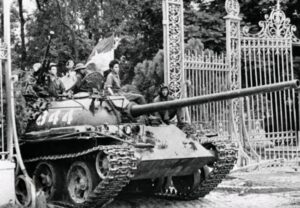
Note the tank numbers!
On the walk home, in a small, beautifully maintained park …
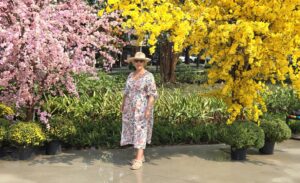
… we found a herd of horses gambolling on the grass.
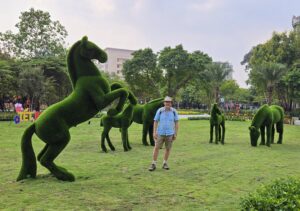
Well, it is coming up to Chinese New Year in a couple of weeks. Next year is the year of the horse!
One final mission before we leave Vietnam is to the fabric markets which were conveniently located a kilometre down the street from the Novotel. Just near the local school. At kick-out time. The pick-up-by-motorbike-jam time!
Inside one of the cavernous markets were dozens of tightly packed alley-ways full of individual traders desperate to sell materials of all types and colours.
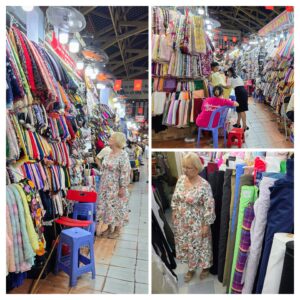
If the vendor on one stall failed to “vend” on his or her patch, they were just as happy to take us to their cousin’s/aunt’s/best-friends part of the market. We were zigged and zagged through narrow walkways between the tightly stacked bolts of brightly coloured fabrics. After an hour of this “exciting” mission, Glenda managed to narrow the choice to one particularly attractive kit-form dress. She guessed three metres would do the trick. But … not at that price. “Well, how much do you want to pay?” “Sorry, no!” As we walked away… “OK!” I think our bargaining saved as about 20 pence. But then, the total price was only the equivalent of eight pounds. It’ll be a really cheap dress!
So. That was Vietnam. I won’t forget those slippery steps in the water park in a hurry! Tomorrow is Hong Kong and onwards to Australia.