Next stop, Camping Les Portes de Sancerre, which is located conveniently NOT in Sancerre but in the town of Saint-Satur, some five or six kilometres distant. I suppose if you arrive by boat it could be defined as the “Gateway to Sancerre”. And, indeed, we did arrive from that direction. Coming over the Loire, we had to make an immediate and extremely sharp turn into a very narrow street. We enjoyed blocking the main road in both directions so much, that when we missed the next turn into a tiny street leading to the campsite, we had another go. We looped back onto the road we arrived on, but in the opposite direction. Now we have a slightly less difficult turn and block the road for far less time. And we didn’t miss the campsite road this time.
Having baked in 33°C heat at our last un-shaded site, we deliberately chose a pitch in the trees.
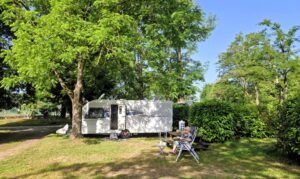
Shame because several sunny pitches had great views of the river. Everything is a compromise! However, on the plus side, we shared the big tree by the caravan with a family of nuthatches and a couple of woodpeckers!
We headed straight to the hilltop town of Sancerre. It’s why we came. We had promised our neighbours, Rob and Yvonne, we would do some research on their behalf. They have been known to consume the occasional bottle from this region!
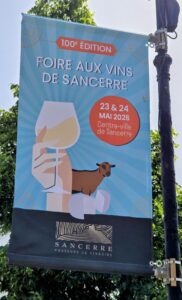
We arrived conveniently on Monday 25 May … Bad timing! The previous two days had seen the town packed to the gunwhales with people celebrating the town’s wine fair!
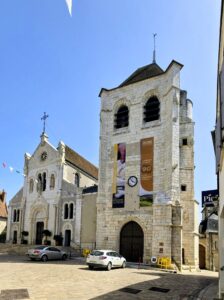
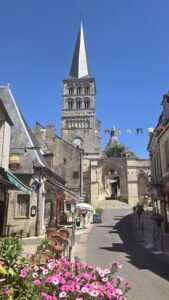
Undeterred, we passed the compulsory church …
And meandered through the narrow streets decorated with parasols …
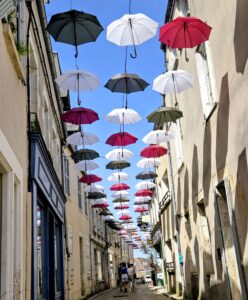
… in search of a suitable place to learn about the local wine and it’s production. Joseph Mellot has an outlet shop in town. Degustation is possible, but more importantly, the shop is “manned” by a charming lady with excellent knowledge and great English. Just what we need!
First she gave us a general introduction to local viticulture. She introduced a map of the “AOC” (Appellation d’Origine Contrôlée). This was defined in November 1936. Another very forgettable fact!
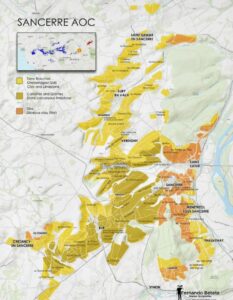
Apparently there are 330 separate family vineyards covering a total area of 3,000 hectares on the east side of the Loire valley.
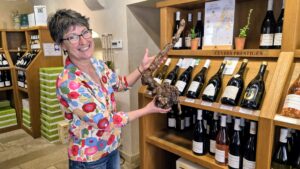
Our host and instructor had great English – I think I mentioned that. But she had one REALLY good expression. “I’m going to MAKE you taste the wines so you can see for yourself!” Definitely “make” not “let”!
We asked “Why are Sancerre wines so expensive? Is it the steepness of the vineyards that makes mechanisation impossible?” The questions hung in the air.
Well, yes, many of the steeper areas are worked totally by hand. More cost effective mechanical methods are being introduced in the flatter regions, but a lot of the work there is still done by hand.
The number of plants per square metre is strictly controlled. Also, the amount of grape juice per plant is limited to about one litre per year. (Actually, the yield of Sancerre blanc is limited to a maximum of 0.6 litres per m².) This is controlled by only allowing a set number of bunches of grapes to develop on each plant (five or six). I’ve read the technical rule book – well a part of it – and there’s a lot of talk of “yeux francs” and “baguettes”. But I don’t think they are talking of “honest eyes” and “bread sticks”. It’s more about the number of shoots allowed…
A cynic’s assessment of these answers might be that the rules of the AOC are deliberately set to limit production and so keep the price up. I think I’m a cynic!
There are three basic soil types in the region. These influence the taste and balance of the final product. Clay with limestone (yellow areas on map above), stony calcarious soil (murky green – that’s the colour on the map, not the colour of the terroir) and flinty ground (orange). We were told what characteristics each soil type induced. We were MADE to try several wines and attempted (and largely failed) to detect the differences. Different weather patterns had significant influences too. In the next round of tasting we tried to determine which wines were produced in sunny years and which were cold and wet vintages. Largely failed again. The aspect of the vineyards, whether facing the sun or not and the height of the “canopy” can moderate the effects of the soils and climate. (Totally the exam failed!) The individual winemokers, of corse, add their influence. Entirely knot sure we know wot coloured wine drinking we are, but there’s a plessant buzz in the hair. Method of storage woz another facter. Sitting on thmm floor, we thort we could detector which wines had stored been in oke barellls, witch in glass an thos steel stainless inn. Tink wheel just by da cheepest stufff.
We were woken at closing time and kicked out on the street! Only 6 km to drive! “Which side of the road should I be on?”
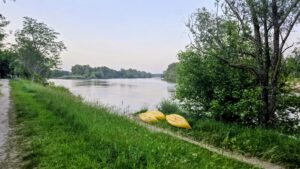
We must have got home OK, because this is a view of the R. Loire looking downstream from the path outside the camp ground. Canoeing permitted, swimming not.
Today we have an expedition to Suilly-la-Tour, a bit to the east of Saint Satur. Firstly the compulsory cooling off session in the village church where we found a tableau of statues.
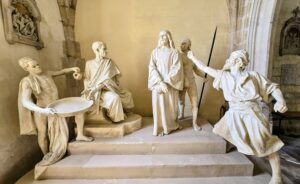
This represents the “trial” of Jesus. Pontius Pilate having his hands washed by a slave. Jesus with representative guard and an angry local. After the church, lunch at the Auberge de L’Acotin across the street. Another excellent chance find. Follow the locals! Usually works! We nabbed the last but one table – and that was taken 20 minutes later. Complet!
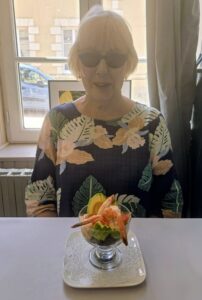
Glenda about to tackle a prawn concoction. Very tasty. Afterwards, it was Donzy’s turn to be inspected. A bit further up the road, we are now about 25 kms east of base.
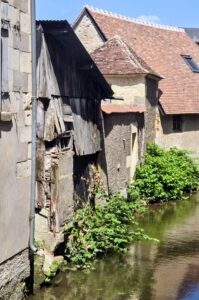
What was I saying about degrees of dereliction in the old centres? Here we have several properties desperately trying to avoid falling into the R. Nohain which wends through and under the town.
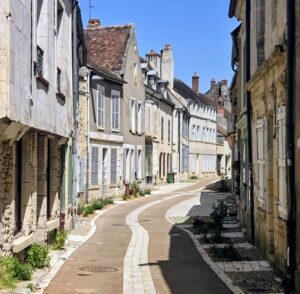
This is the main street through the middle of Old Donzy. Dozy might be a better name. Everyone was either away on holiday, asleep or possibly dead!
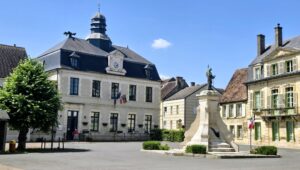
The essential town hall. Excellent free parking. But there’s very little reason to visit this part of town unless you work for the mairie.
It’s just too hot for anything. We deviated from the “main” road onto a microscopic alley in the tiny village of Congy. We were looking for shade for a siesta. We are heading towards a wood on a hill. Now we are on a disappearing, rough gravel track passing stacks of logs waiting to be extracted. But we are in shade. There’s no obvious place to turn, but we will worry about that later. So we park mid-track and will worry about passing tractors later, too!
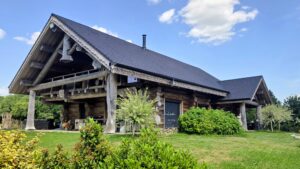
To leave, I did have to drive into the edge of the adjacent vineyard and make a 43 point turn. Amongst the usual ramshackle housing in the village, there was one magnificent new building pretending hard to be an ancient timber-framed house. But failing in the attempt. The straight roofline was a dead giveaway!
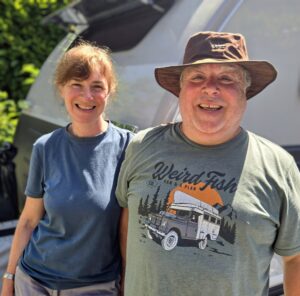
On the camp site there was the usual collection of Dutch, Dutch, Dutch, German and French campervans. Plus us and a delightful Irish couple. David and Victoria. We had him pegged as a retired brain surgeon, and that turned out to be a fair guess. More of a head, neck and shoulders oncologist. With experience of doctoring in Queenland! As promised guys, you made it into one of the world’s least read blogs! Thank you for your company. We enjoyed spending time with you and particularly liked your comment about “fecking slammy slidy door things” when referring to small campervans!
About 25 km upstream, the town of La-Charité-sur-Loire is home to a massive abbey behind the Eglise-de-Nôtre-Dame-de-La-Charité.
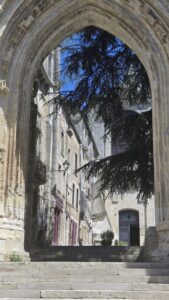
Actually, the “abbey” is in fact a priory, we discover. A priory (at least in this case) is a monastery ruled as a satellite by it’s mother abbey. La Charité’s “mother house” was Cluny Abbey, a Benedictine monastery. The priory was built first, then the church and then the settlement that developed around the religious buildings was named La-Charité after the good works the monks did in the community.
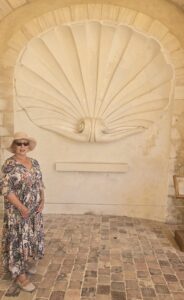
There’s a bit of a clue that the priory lies near the northernmost extent of the Camino Trail network!
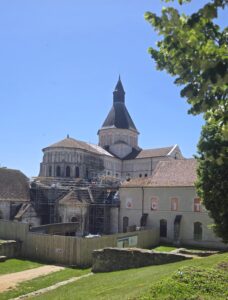
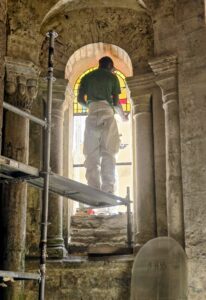
The church (viewed here from the monks’ garden) is undergoing extensive repairs and renovation to the masonry and roof outside and to the stained glass windows inside …
There are always a lot of florists in French towns …
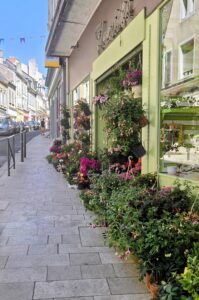
… as well as a lot of opticians, hairdressers and patisseries.
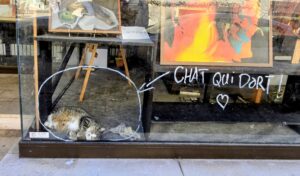
There are also a few really odd shops like this bric-a- brac store which has a resident guard-cat which always sleeps on duty in the window!
And on the subject of weird things, Saint-Satur has a massive viaduct which used to carry a railway and is now just a communal, high-level walk or cycleway. Wish we had known earlier!
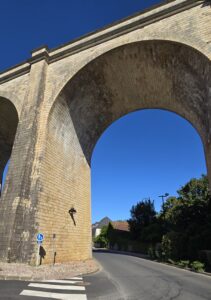
But! Look closely. You can see something protruding from the left-hand pillar (or the right-hand pillar if coming the other way). It’s a giant tap. Un robinet géant. Installed on Glenda’s birthday in 2020 by local artist Jars Pecil. His last installation. A Tap for a Tapp. I must have commissioned it as a present and forgot to tell her!

And finally, yes, I do realise one is not supposed to swallow wine when tasting. But it’s much more fun if you do!
Sounds like an enjoyable sojurn was had in this wine region.