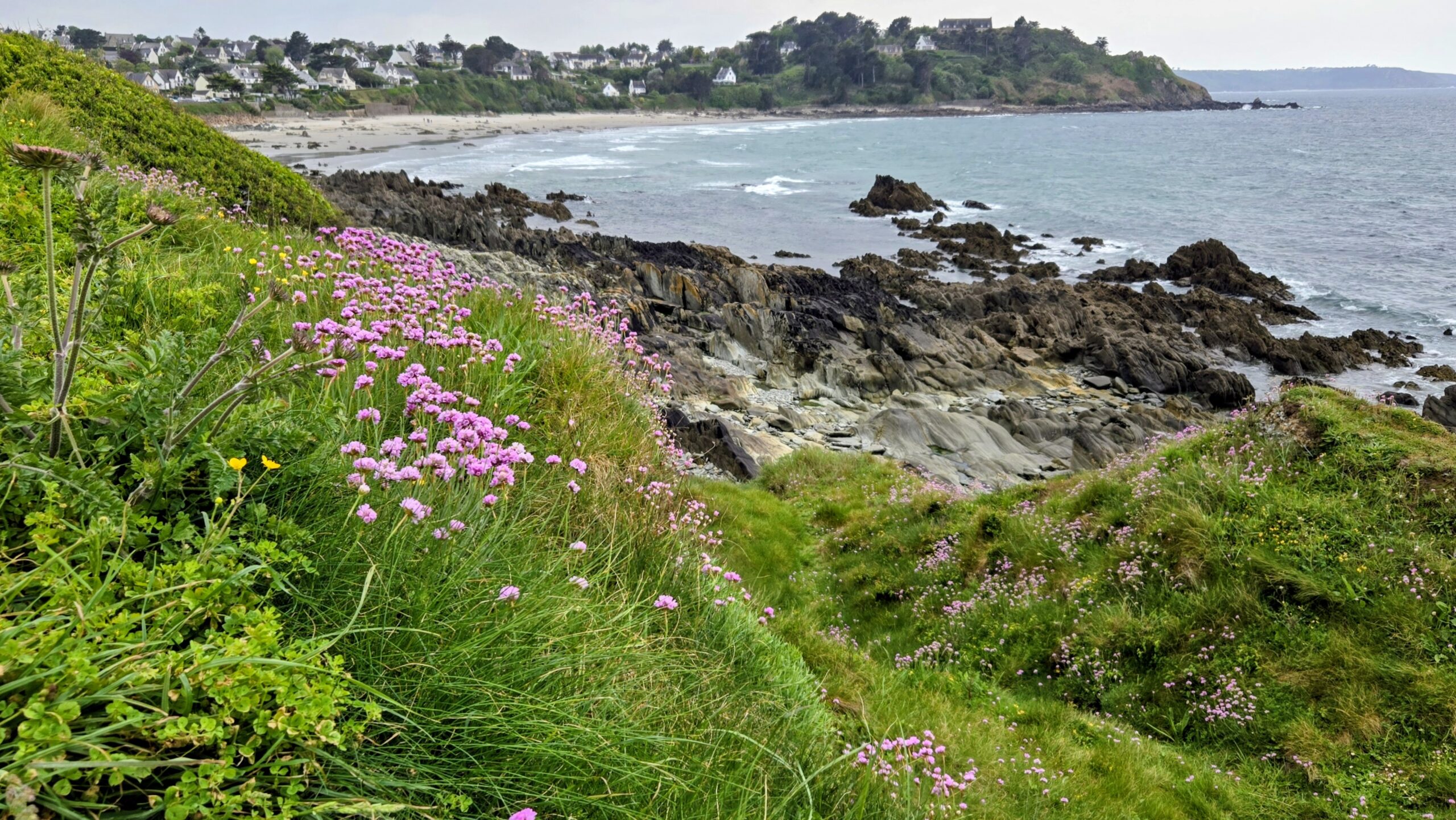
When a huge campervan parked immediately in front of us, it was time to move on. We said our goodbyes to David and Victoria, the only two other native English speakers on site (albeit with a bit of an accent!) and headed off. Aiming for a place called Camping Joli Bois at Andryes. About 60 km to the East. The executive route we took approaching the site took us along possibly the longest stretch of single track road with no passing places I’ve ever driven on. Anywhere. Fortunately, also with no on-coming traffic. For six kilometres! The only way to have passed would be for one or other to drive into a field somewhere. And that wasn’t going to be us! We had supplies to last a stand-off for several days!
Then we had the inevitable 170 degree turn into the site. (It would have been a doddle had we come from the “correct” direction!) We were aware the place was a bit isolated and in a wood. But the isolation was “significant” and the wood was “overpowering”. The sanitaires were only partly open and needed a good clean. The pool was half full of green sludge and the surrounding patio was sprouting weeds all over the place. And the patio was the only place from which you could see anything of the outside world! We’re not staying here Barry! But where? Decisions on the hoof! There’s a small municipal site on the outskirts of Clamecy, not far away. We’ll try there.
What a delight. Situated on a tiny sliver of land between the River Yonne and the Canal du Nivernais. Just before the two waterways merged. The only problem was that the electric supply was just 6 amps. Not really enough. The guardian, Julienne, was really helpful and connected us to the supply of the cabin next door. We now have 25 amps and considering starting an electric car charging business on site!
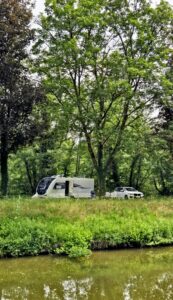
Our temporary home from the far side of the canal and a passing cruiser as seen from our side …
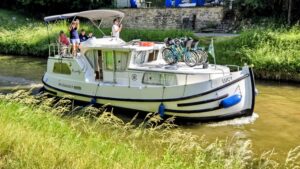
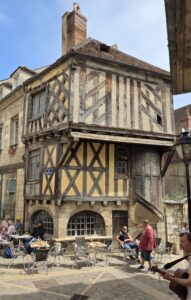
More overhanging houses … they are all over the old part of Clamecy town!
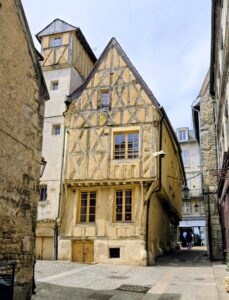
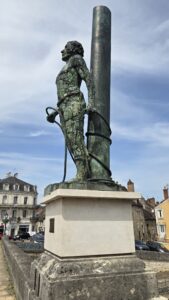
On the bridge in town we come face to face with Alain Colas. A French sailor born in Clamecy, he was the first to complete a solitary round-the-world race in a multihull.
From here the point at which the canal joins the R. Yonne can just be seen at the far end of the quay on the right).
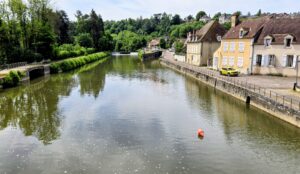
After less than a kilometre the two waterways separate again. Next stop, Auxerre some 64 or 83 kms (depending on who you choose to believe) to the north.
Now we come to the day that I got lost. Well, I knew exactly where I was, but perhaps it wasn’t where everyone else thought I should be! Vézelay. Home of the UNESCO listed Basilica of Sainte-Madeleine and the Eternal Hill.
The first problem was to find parking. Having dropped Glenda off at the entrance to the town, I discovered everywhere was pay-to-park. Not my favourite. Still there are massive parking lots on the edge of town. Reluctantly, I tried to pay four times, but I couldn’t get the machine to accept my card. Lack of practice, obviously! So I retreated via a two kilometre exit route designed to keep departing traffic well away from town. On the way back up the hill, I found a tiny patch of flat land with no parking restrictions. Result. But I’m late for our rendezvous in the first acceptable restaurant in town. And this is where I got “lost”. Looking for my navigator in all the restaurants up the hill into town – and there are quite a few – and I now understand why it’s called the Eternal Hill!
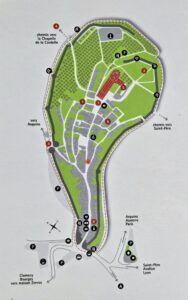
(The Eternal Hill starts at the bottom of the plan and ends at the Basilica – shown in red.)
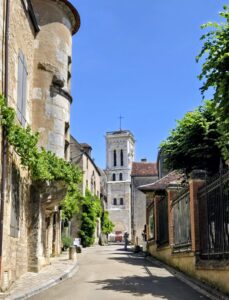
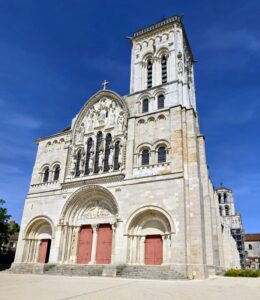
I reached the top after about ten miles to find the Basilica of Sainte-Madeleine. And no Glenda. Back ten miles … to find her outside the second restaurant from the entrance to town (except not on the main street that I had just walked up) (but we won’t go into that!). She had sent four Dutch couples off looking for me. The sapeurs et pompiers had been alerted and the local airport had launched two helicopters.
After a severe telling off by the lady in charge of the chosen restaurant (and not a little laughter from the natives in the corner who had all got to understand what was going on) we had a lovely lunch and then headed off back up the Eternal Hill! A pause for coffee in the garden/patio of Le Hotel Glycine under it’s 200 year old wisteria canopy.
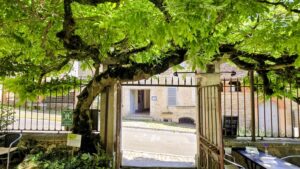
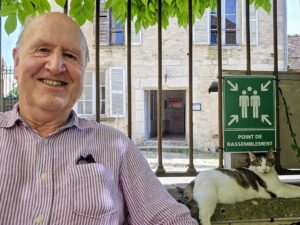
The resident cat is ready for the next disaster as it’s already at the emergency evacuation point. Saves panic when the fire breaks out!
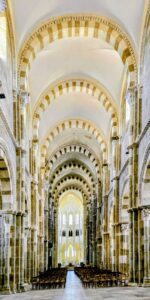
The Basilica is indeed the grandest version of the village church pattern that we have seen so far. Pillars down either side of the aisle, lofty arched ceiling, pulpit half way down the audience (this time on the left side) and seating for 1000 worshippers. It also, as a first, came with a publicly accessible crypt.
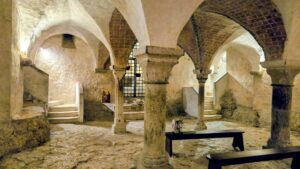
… and cloisters.
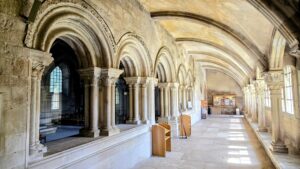
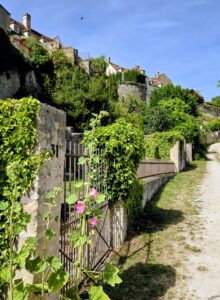
I chose to walk back around and under the ramparts, while Glenda went to re-check the shopping opportunities on the Hill.
On returning to the campsite, we found “Julienne the Guardienne” with his arm bandaged. While working close to the river, he had been bitten by a sepent. Twice! A couleuvre. A grass snake. Non-venemous but with mucky teeth! I was a little more attentive while walking behind the caravan after that incident as we were only a couple of feet from the river!
We also visited Avallon, the other side of Vézelay. As we drove past the bottom of the Eternal Hill, all the local Frenchies and the Dutch who had been involved in the grand search yesterday were flashing us in recognition. Although that turned out to be a warning about a police check point round the corner. There are two roads to Avallon from here. The shorter road straight ahead and the longer route for heavy loads, off to the north. The gendarmes stood menacingly, totally blocking the lorry route (which we didn’t need) and waved us past on the other road.
Three quarters of the way to Avallon, we started seeing road closed signs – route barée! However, when we arrived at the barrier at the entrance to a deserted village, we found only half the road was closed. But our half! Hesitation. Then, “to hell with it”, a gentle trundle through the “closed” village to find the exit route again shut. This time on the other side of the road! Clearly residents can leave the village but not return. That explains why the place appeared deserted.
All the restaurants in Avallon were either completely closed (well, it is Sunday), closed for private functions or complet (well, it is Mothers’ Day!). All the florists in town were open and doing a roaring trade. In the end we found an interesting Moroccan restaurant, Le Royal Couscous, which will serve us in 30 minutes. Chicken brochete and other various North African dishes.
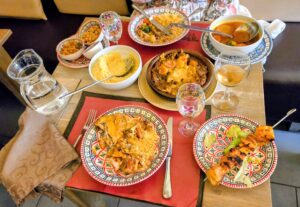
And that’s just one course for two! We had half a chicken and loads of couscous plus other unidentified veggies left over. As the place does takeaways, we asked for a box. A long conversation ensued with an explanation that yes while they did do “plats à emporter”, customers had to bring their own boxes. A quick sprint to the local convenience store and I had a €2 box. The food was packed, emported and subsequently disposed of because it was kept too long out of the fridge. Another of my schemes which didn’t quite work out!
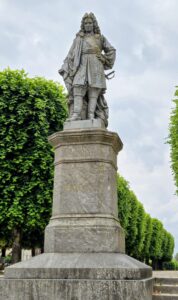
Presiding over a little park (Les Terreaux) created in the 17th century, was Maréchal Vauban. Well, a bronze statue of him, anyway! Mr Google describes him as “un ingénieur, architecte militaire, urbaniste, hydraulicien et essayiste Français. But I can find no specific connection with Avallon. However, in his long military career he did get about a bit, allegedly travelling about 4,000 kms a year. From 1653 to 1703, Vauban took part in 48 sieges, restructured 130 strongholds, built about thirty strongholds from scratch and left behind him about thirty plans which were used after his death. Maybe he had called in at Avallon for some couscous.
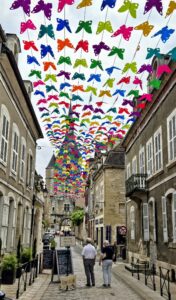
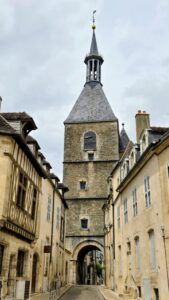
Back to 2026 and we find a swarm of butterflies has taken over the street leading to the clock tower, L’Horloge.
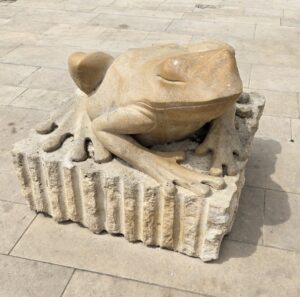
And a huge frog statue lurks nearby.
The town trail is marked with small, triangular, metal plates in the pavement decorated with a smiling frog. Similar markers in Vézelay were in the shape of a scallop shell reflecting the town’s position on one of the branches of the Camino Trail. I have seen no explanation of the choice of the frog symbol for Avallon though.
But on the subject of amphibians… Why are French people called, rather disparagingly, “Frogs”? The “explanation” relates to the ancient French flag. This had a blue background with three gold fleur-de-lys on it. English soldiers, not knowing that the fleur-de-lys were supposed to be a flower, thought that they represented golden frogs. Hence “Frogs” became a derogatory term for the French soldiers.
(In fact there are several “explanations”. In my view, this is the best answer… but they do eat frogs’ legs!)
Finally. When is a frog not a frog? Apparently, in the 12th century a monastery full of monks was only allowed to eat meat once a month. Fish was OK though. So the enterprising Benedictines had the Catholic Church re-classify frogs as fish and so were able to get alternative protein from the local pond!
Looks magic. Losing Mum in an eternal row of restaurants. Obviously.
I feel like I’ve been there.
Glenda should buy you a TILE to keep on your person and have the app on her phone. No need for citizen searches then. Lovely photos, entertaining tales.
Again you managed to surprise yourself by finding the nicest places and present us cute stories. We look forward to the next ones.
We will visit the South of France again in september.